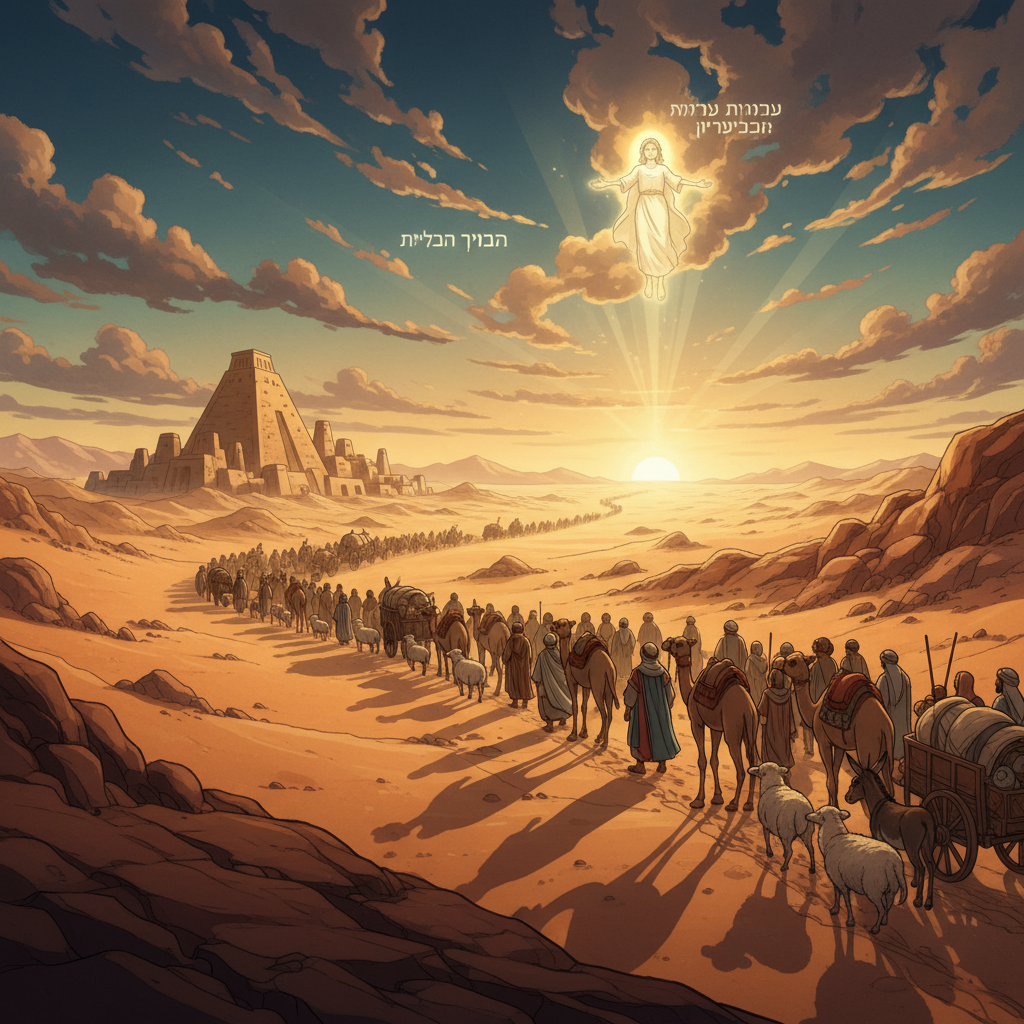
Daily Bible Comics

Scripture Stories Brought to Life

Today's Story

2 Kings chapter 5 tells the story of Naaman and teaches us about obedience, humility, and God’s power to heal. Naaman was the commander of the army of Syria. He was a brave and important man, but he h...
2 Kings chapter 5 February 28, 2026

2 Kings chapter 5: THE BRAVE LITTLE MAID

2 Kings chapter 5 tells the story of Naaman and teaches us about obedience, humility, and God’s powe...

Read Today's Comic

Comic Archive

2 Kings chapter 5 tells the story of Naaman and teaches us about obedience, humility, and God’s power to heal. Naaman was the commander of the army of Syria. He was a brave and important man, but he h...
2 Kings chapter 5
February 28, 2026

2 Kings chapter 5: THE BRAVE LITTLE MAID

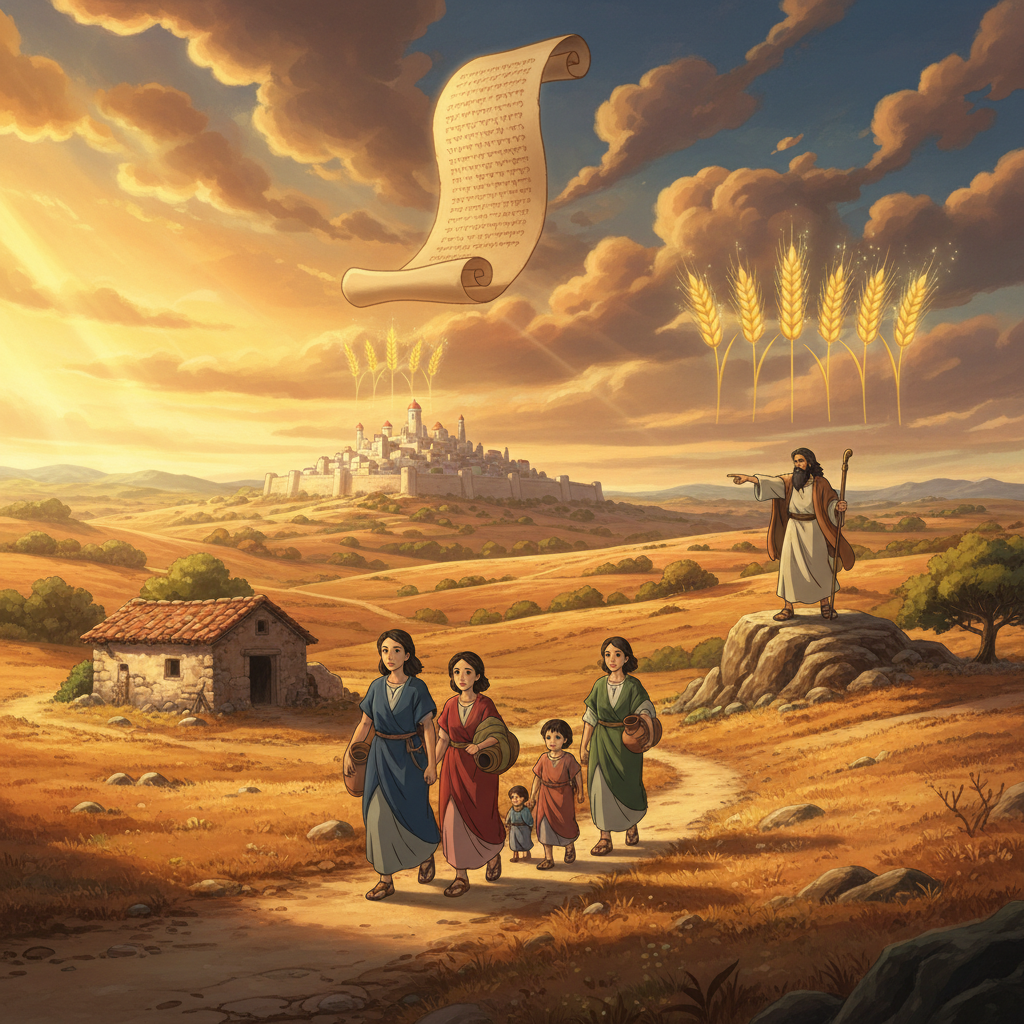
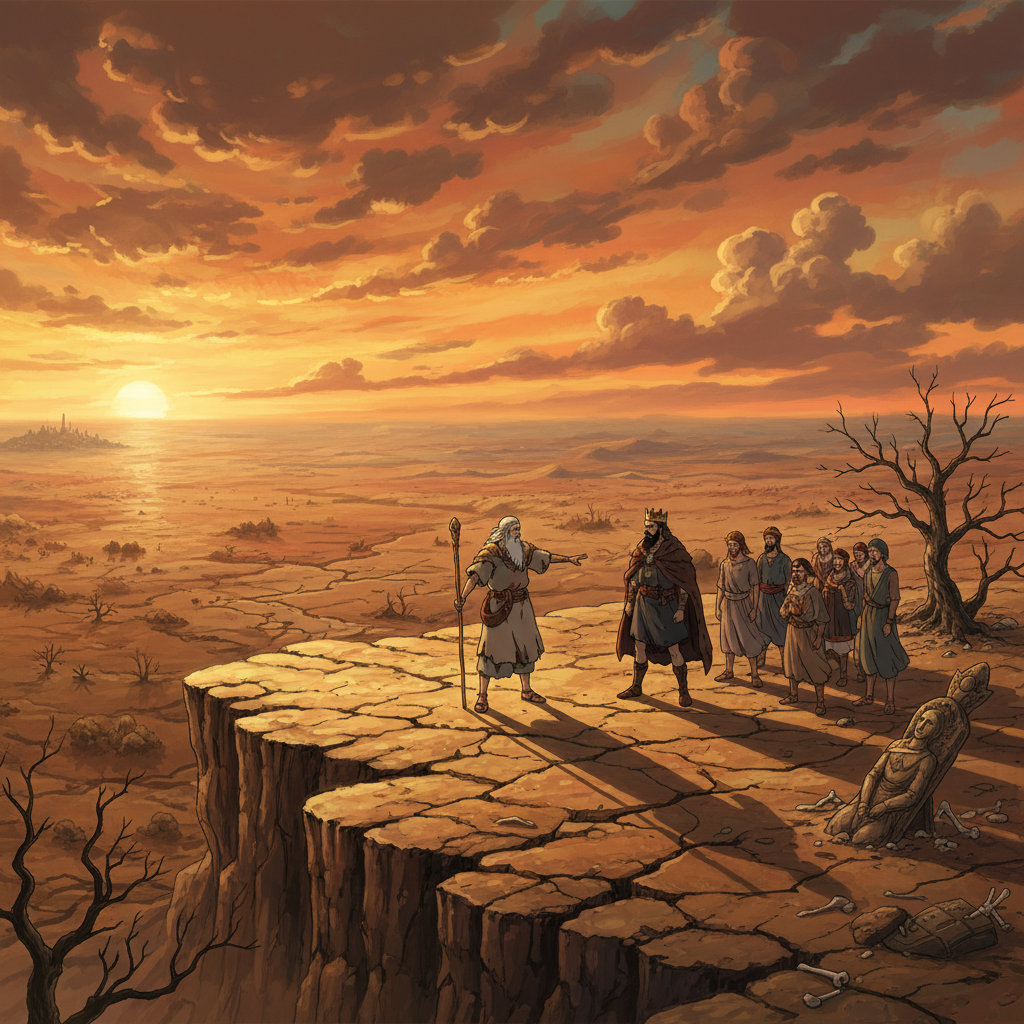
2 Kings chapter 5 tells the story of Naaman and teaches us about obedience, humility, and God’s power to heal. Naaman was the commander of the army of Syria. He was a brave and important man, but he had a serious skin disease called leprosy. Even though he was rich and powerful, he could not heal himself. A young Israelite girl worked as a servant in Naaman’s house. She had been taken from her home during a raid. She told Naaman’s wife that there was a prophet in Israel who could heal Naaman. Naaman listened to her words. Naaman went to the king of Syria, who sent him to the king of Israel with a letter and many gifts. When the king of Israel read the letter, he became afraid because he thought Syria wanted to start a war. Elisha heard about this and asked for Naaman to be sent to him. Naaman arrived at Elisha’s house with his horses and chariot. Elisha did not come out to meet him. Instead, he sent a messenger to tell Naaman to wash himself seven times in the Jordan River. Naaman became angry. He expected Elisha to come out and perform a big miracle. He also thought the rivers in his country were better than the Jordan River. Naaman’s servants spoke kindly to him and encouraged him to obey. Naaman finally listened. He went to the Jordan River and washed seven times, just as Elisha had said. After the seventh time, his skin became clean like that of a young child. He was completely healed. Naaman returned to Elisha and thanked him. He said he now knew that there was no God except the Lord. He offered Elisha gifts, but Elisha refused to take anything. Later, Elisha’s servant Gehazi ran after Naaman and lied to him, saying Elisha needed gifts. Naaman gave him silver and clothes. Gehazi hid them and then lied to Elisha. Because of his greed and dishonesty, Elisha said that Naaman’s leprosy would come upon Gehazi. Gehazi left with leprosy. This chapter teaches us that God’s blessings cannot be bought. It also shows that obedience and humility bring blessings, but greed and lying bring punishment.

2 Kings chapter 2 tells us about the time when Elijah was taken up to heaven and Elisha became the next prophet of Israel. Elijah knew that God was going to take him away soon. He traveled from place ...
2 Kings chapter 2
February 25, 2026

2 Kings chapter 2: A Bible Story

2 Kings chapter 2 tells us about the time when Elijah was taken up to heaven and Elisha became the next prophet of Israel. Elijah knew that God was going to take him away soon. He traveled from place to place, and Elisha followed him closely. They went to Bethel, Jericho, and then to the Jordan River. Each time, Elijah told Elisha to stay behind, but Elisha refused to leave him. Elisha loved Elijah and wanted to stay with him until the end. When they reached the Jordan River, Elijah took off his cloak, rolled it up, and struck the water. The river parted, and they walked across on dry ground. This was a miracle that showed God’s power was with Elijah. After they crossed, Elijah asked Elisha what he wanted before he was taken away. Elisha asked for a double portion of Elijah’s spirit. This meant he wanted to receive special strength and blessing from God so he could continue Elijah’s work. Elijah told him that if he saw him being taken away, his request would be granted. As they walked and talked, suddenly a chariot of fire and horses of fire appeared. Elijah was taken up to heaven in a whirlwind. Elisha saw it happen and cried out in sadness because his teacher was gone. Elijah’s cloak fell to the ground, and Elisha picked it up. Elisha returned to the Jordan River and struck the water with Elijah’s cloak. He asked where the Lord was, and the water parted again. This showed that God’s power was now with Elisha. The other prophets saw this and knew that Elisha was now God’s chosen prophet. After this, the people of Jericho asked Elisha to help them because their water was bad and the land was not growing crops. Elisha threw salt into the spring and said that the Lord had healed the water. From that time on, the water was good. Later, as Elisha was traveling, some boys made fun of him. He warned them in the name of the Lord, and two bears came out of the woods and attacked them. This showed that it is wrong to mock God’s servant and that God’s name should be respected. This chapter teaches us that God’s work continues from one generation to the next. It also shows that God is powerful and faithful. When one servant finishes his work, God raises up another. It reminds us to respect God and those who serve Him.

CHARIOT OF FIRE
February 25, 2026

CHARIOT OF FIRE

2 Kings chapter 1 begins after King Ahab dies. His son Ahaziah becomes king of Israel. Ahaziah did evil things just like his father and mother. He worshipped false gods and did not follow the Lord. On...
2 Kings chapter 1
February 24, 2026

2 Kings chapter 1: The True God

2 Kings chapter 1 begins after King Ahab dies. His son Ahaziah becomes king of Israel. Ahaziah did evil things just like his father and mother. He worshipped false gods and did not follow the Lord. One day, Ahaziah fell through the upper window of his palace in Samaria and was badly hurt. He was very sick because of the fall. Instead of asking the Lord for help, he sent messengers to ask Baal-Zebub, the god of Ekron, if he would recover. This showed that Ahaziah did not trust the true God. God sent the prophet Elijah to meet the messengers on the road. Elijah told them to go back to the king and give him a message. Elijah asked, “Is it because there is no God in Israel that you are going to ask Baal-Zebub?” Then he said that because Ahaziah had done this, he would not recover. He would die in his bed. The messengers returned to the king and told him what the man had said. Ahaziah asked what the man looked like. They said he wore a garment of hair with a leather belt around his waist. The king knew it was Elijah. Ahaziah sent a captain with fifty soldiers to bring Elijah to him. They found Elijah sitting on a hill. The captain ordered him to come down. Elijah answered that if he was a man of God, fire would come down from heaven. Fire came down and destroyed the captain and his fifty soldiers. The king sent another captain with fifty more soldiers. The same thing happened. Fire came down from heaven and destroyed them. Then the king sent a third captain with fifty soldiers. This captain was wise and humble. He went up to Elijah, knelt before him, and begged for mercy. He asked Elijah to spare his life and the lives of his men. This time, God told Elijah to go with the captain and not be afraid. Elijah went to the king and gave him the same message again. Because Ahaziah had asked a false god instead of the Lord, he would die. Just as Elijah said, Ahaziah died. Since he had no son, his brother Jehoram became king. This chapter teaches us that God is the only true God and we should trust Him. It also shows that pride can lead to destruction, but humility can bring mercy. God wants us to turn to Him, especially when we are sick or in trouble.

1 Kings chapter 22 tells about the last days of King Ahab and a battle that changed everything. For three years there was no war between Israel and Syria. Then King Ahab of Israel wanted to take back ...
1 Kings 22
February 23, 2026

1 Kings 22: The Death of Ahab

1 Kings chapter 22 tells about the last days of King Ahab and a battle that changed everything. For three years there was no war between Israel and Syria. Then King Ahab of Israel wanted to take back a city called Ramoth Gilead from the Syrians. King Jehoshaphat of Judah came to visit Ahab. Ahab asked Jehoshaphat to help him fight against Syria. Jehoshaphat agreed but said they should first ask the Lord for advice. Ahab gathered about four hundred prophets. All of them told Ahab that he would win the battle. But Jehoshaphat felt unsure and asked if there was another prophet of the Lord they could ask. Ahab said there was one more prophet named Micaiah, but he did not like him because Micaiah usually spoke bad news. Micaiah was brought before the kings. At first he said Ahab would win, but he was speaking in a way that showed he was not serious. Ahab told him to speak the truth. Then Micaiah told the real message from God. He said Israel would be scattered like sheep without a shepherd. This meant the king would die. Micaiah explained that the other prophets had been allowed to believe a lie so that Ahab would go into battle and face judgment. Ahab did not like this message. He put Micaiah in prison and gave orders to give him only bread and water until he returned safely. But Micaiah said that if Ahab returned safely, then the Lord had not spoken through him. Ahab and Jehoshaphat went to battle. Ahab tried to protect himself by wearing a disguise, but he told Jehoshaphat to wear his royal robes. During the battle, a soldier shot an arrow into the air at random. The arrow struck Ahab between the pieces of his armor. He was badly wounded. He stayed in his chariot during the battle and died that evening. When Ahab’s chariot was washed, dogs licked up his blood, just as the prophet Elijah had said earlier. This showed that God’s word always comes true. After Ahab died, his son Ahaziah became king of Israel. The chapter also tells about King Jehoshaphat of Judah. Jehoshaphat tried to do what was right and followed the ways of the Lord, though not perfectly. This chapter teaches us that we should listen to the truth, even when it is hard to hear. It also reminds us that God’s word always happens just as He says. No one can escape God’s plan, even if they try to hide.

1 Kings chapter 20 tells us about battles between Israel and Syria during the time of King Ahab. Even though Ahab was not a good king, God still showed mercy to Israel. The king of Syria was named Ben...
1 Kings 20
February 21, 2026

1 Kings 20: God Shows Mercy to Ahab

1 Kings chapter 20 tells us about battles between Israel and Syria during the time of King Ahab. Even though Ahab was not a good king, God still showed mercy to Israel. The king of Syria was named Ben-Hadad. He gathered a large army and attacked Samaria, the capital of Israel. He sent a message to King Ahab demanding Ahab’s silver, gold, wives, and children. At first, Ahab agreed because he was afraid. But then Ben-Hadad demanded even more. He wanted his servants to search Ahab’s palace and take anything they liked. This time, Ahab refused. A prophet came to Ahab with a message from God. The prophet said that even though the Syrian army was very large, God would help Israel win. This victory would show that the Lord is the true God. Ahab obeyed the instructions given by the prophet. The young officers led the attack, and Israel defeated the Syrians. Ben-Hadad escaped on a horse. Later, the prophet warned Ahab that the Syrian army would return the next year. The Syrians believed that Israel’s God was only powerful in the hills, so they planned to fight on the plains. But God sent another message saying He would give Israel victory again so that everyone would know He is God everywhere. The two armies met again. Even though the Syrian army was much larger, Israel defeated them. Many Syrian soldiers were killed, and the rest fled into a city. A wall fell on many of them. Ben-Hadad hid and then asked Ahab for mercy. Instead of following God’s will, Ahab made a peace agreement with Ben-Hadad and let him go. A prophet then spoke to Ahab and explained that because he had spared the enemy king whom God had decided to destroy, there would be consequences. Ahab went home upset and angry. This chapter teaches us that God is powerful everywhere, not just in certain places. It also shows that God can use anyone, even imperfect leaders, to accomplish His plans. But it warns us that we must obey God fully, not just partly. When we ignore God’s instructions, there are consequences.

1 Kings chapter 19 tells us what happened after the great victory on Mount Carmel. Even though God had sent fire from heaven and proved that He is the true God, trouble was not over for Elijah. When Q...
1 Kings 19
February 20, 2026

1 Kings 19: Elijah's Final Acts

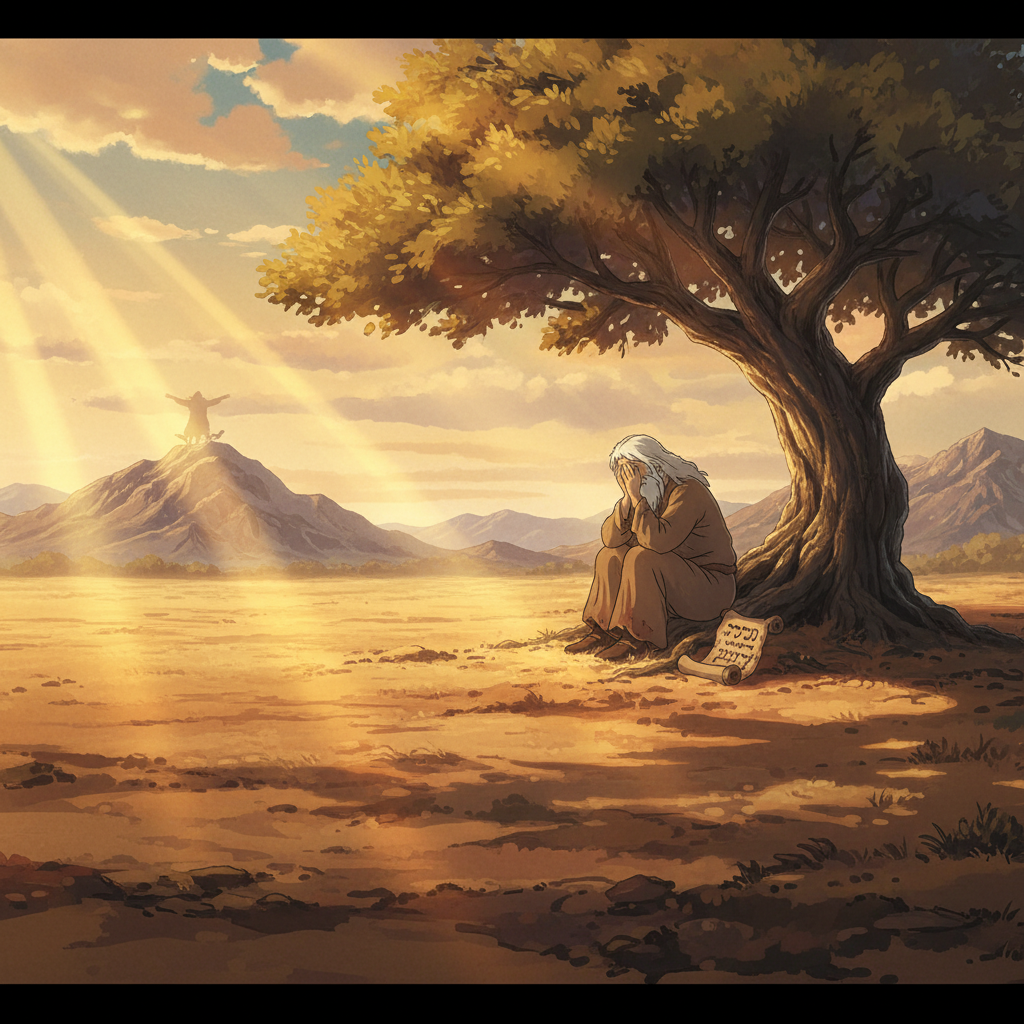
1 Kings chapter 19 tells us what happened after the great victory on Mount Carmel. Even though God had sent fire from heaven and proved that He is the true God, trouble was not over for Elijah. When Queen Jezebel heard what Elijah had done to the prophets of Baal, she became very angry. She sent a message to Elijah saying that she would kill him within one day. Elijah became afraid and ran away to save his life. He traveled into the wilderness and sat under a tree. He felt very tired and discouraged. He even told God that he felt alone and wanted to die. But God did not leave Elijah. An angel came and touched him. The angel told him to get up and eat. Elijah saw bread and water near him. He ate and drank, then lay down again. The angel came a second time and told him to eat because the journey ahead was long. After eating again, Elijah traveled for forty days and nights until he reached Mount Horeb, the mountain of God. There, Elijah stayed in a cave. God spoke to him and asked, “What are you doing here, Elijah?” Elijah explained that he had tried to serve God faithfully, but the people had turned away. He said he felt like he was the only one left who still followed the Lord. God told Elijah to stand on the mountain because the Lord was about to pass by. First, a strong wind came and broke the rocks apart. But the Lord was not in the wind. Then there was an earthquake, but the Lord was not in the earthquake. Then there was a fire, but the Lord was not in the fire. After the fire, there was a gentle whisper. When Elijah heard the whisper, he covered his face. God spoke to him in the quiet voice. God told Elijah that he was not alone. There were still seven thousand people in Israel who had not worshipped Baal. God then gave Elijah new instructions. He told him to anoint new kings and to choose Elisha to be the next prophet. Elijah obeyed and found Elisha working in a field. Elijah placed his cloak on Elisha, which showed that Elisha would follow him and become a prophet. Elisha left his old life and began to serve with Elijah. This chapter teaches us that even strong believers can feel afraid and discouraged. But God cares for us when we are weak. He provides rest, food, and comfort. It also shows that God sometimes speaks in quiet ways. We must listen carefully for His voice. Finally, we learn that we are never truly alone when we belong to God.

1 Kings chapter 18 continues the story of the prophet Elijah during the time of King Ahab. There had been no rain in Israel for a long time, just as Elijah had said. The land was dry, crops had failed...
1 Kings 18
February 19, 2026

1 Kings 18: No Rain in Israel

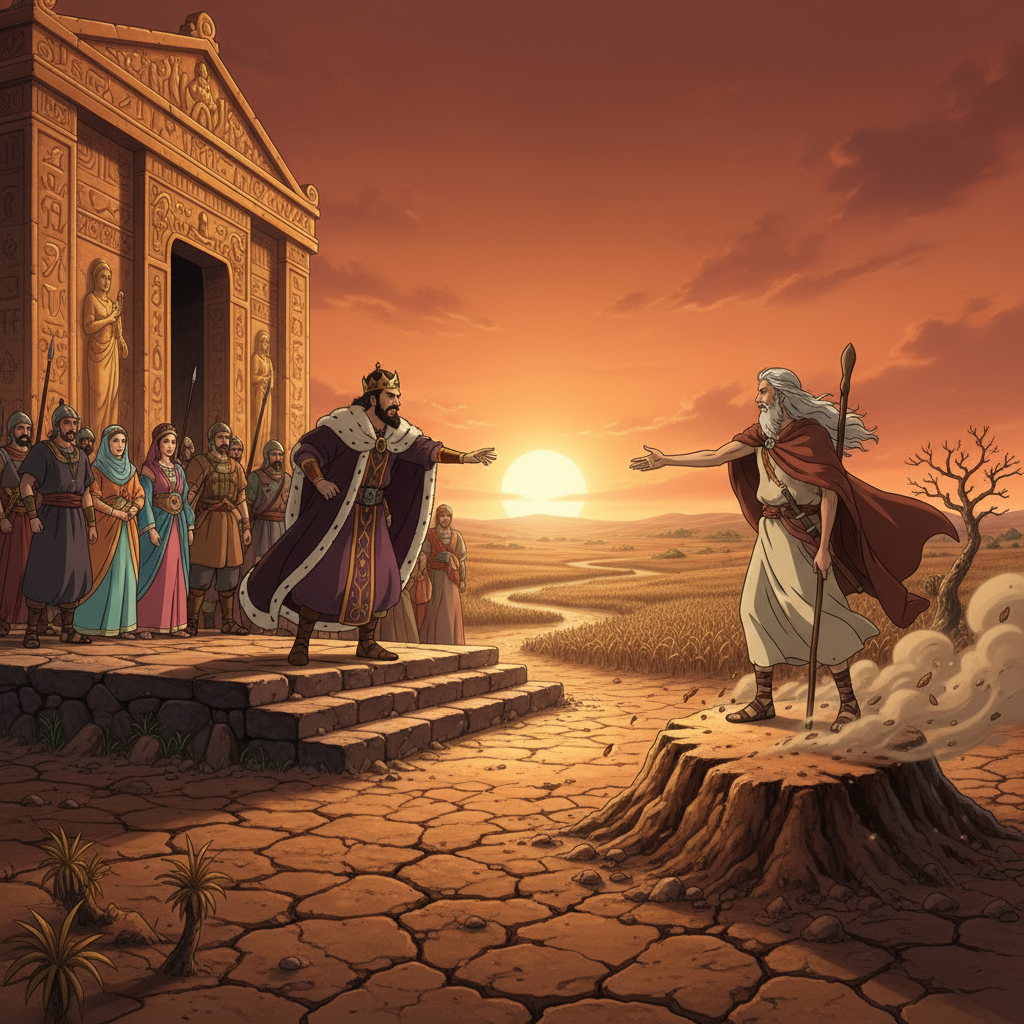
1 Kings chapter 18 continues the story of the prophet Elijah during the time of King Ahab. There had been no rain in Israel for a long time, just as Elijah had said. The land was dry, crops had failed, and there was very little food. The drought showed that the false god Baal had no power, even though many people were worshipping him. After many days, God told Elijah to go and meet King Ahab again. God promised that He would send rain. When Elijah met Ahab, Ahab blamed him for bringing trouble to Israel. But Elijah said it was Ahab and his family who had caused trouble by turning away from the Lord and worshipping Baal. Elijah then challenged Ahab to gather all the people of Israel and the prophets of Baal on Mount Carmel. There were 450 prophets of Baal. Elijah stood alone as God’s prophet. In front of everyone, Elijah spoke to the people and asked how long they would keep changing their minds. He told them they must decide whether the Lord was the true God or Baal was. Elijah suggested a test. Two bulls would be prepared for sacrifice, but no fire would be set to them. The prophets of Baal would call on their god to send fire. Elijah would call on the Lord. The God who answered with fire would be shown to be the true God. The people agreed. The prophets of Baal went first. They prayed loudly from morning until noon, asking Baal to send fire. Nothing happened. Elijah even told them to shout louder. They continued praying and even hurt themselves, but there was still no answer. Baal did not send fire. Then it was Elijah’s turn. He repaired the altar of the Lord that had been broken down. He placed the wood and the bull on it. Then he poured water over the sacrifice three times until everything was very wet. This made it even harder for fire to start. Elijah prayed a simple prayer, asking God to show the people that He alone is God. Immediately, fire came down from heaven. It burned up the sacrifice, the wood, the stones, and even dried up the water in the trench around the altar. When the people saw this, they fell to the ground and said that the Lord is God. This miracle clearly showed that God is powerful and real. After this, Elijah told Ahab that rain was coming. Elijah prayed again, and a small cloud appeared in the sky. Soon the sky grew dark, the wind blew, and heavy rain began to fall. The drought had ended. This chapter teaches us that God is the only true God. It shows that He is powerful and hears prayer. It also teaches that people must choose whom they will serve. God proved Himself stronger than any false god.

1 Kings chapter 17 introduces us to the prophet Elijah. This chapter shows God’s power and care during a time of great trouble in Israel. King Ahab was ruling Israel, and he did very evil things. He w...
1 Kings 17
February 18, 2026

1 Kings 17: Prophet Elijah

1 Kings chapter 17 introduces us to the prophet Elijah. This chapter shows God’s power and care during a time of great trouble in Israel. King Ahab was ruling Israel, and he did very evil things. He worshipped false gods and led the people away from the Lord. Elijah came to King Ahab with a message from God. He said that there would be no rain or dew for several years except by his word. This meant there would be a drought, and crops would not grow. This was a punishment because the people had turned away from God. After giving the message, God told Elijah to go and hide near the Brook Cherith. There, God provided for him in a special way. Ravens brought him bread and meat every morning and evening, and he drank water from the brook. This shows that God can take care of His people in surprising ways. After some time, the brook dried up because there was no rain. Then God told Elijah to go to a town called Zarephath. God said a widow there would provide food for him. When Elijah arrived, he saw the widow gathering sticks. He asked her for water and a piece of bread. The widow explained that she only had a small amount of flour and oil left. She was planning to make one last meal for herself and her son before they would starve. Elijah told her not to be afraid. He said that if she first made a small loaf of bread for him, God would make sure that her flour and oil would not run out until the rain returned. The widow obeyed. Just as Elijah said, the flour and oil did not run out. Every day there was enough food for Elijah, the widow, and her son. This miracle showed that God rewards faith and obedience. Later, the widow’s son became very sick and stopped breathing. The widow was very upset and thought she was being punished. Elijah took the boy upstairs and prayed earnestly to God. He asked God to bring the child back to life. God heard Elijah’s prayer, and the boy came back to life. Elijah brought him down to his mother. She then said she knew that Elijah was truly a man of God and that God’s word was true. This chapter teaches us that God is powerful over nature, that He provides for His people, and that He hears prayer. Even during hard times, God can do miracles and care for those who trust Him.

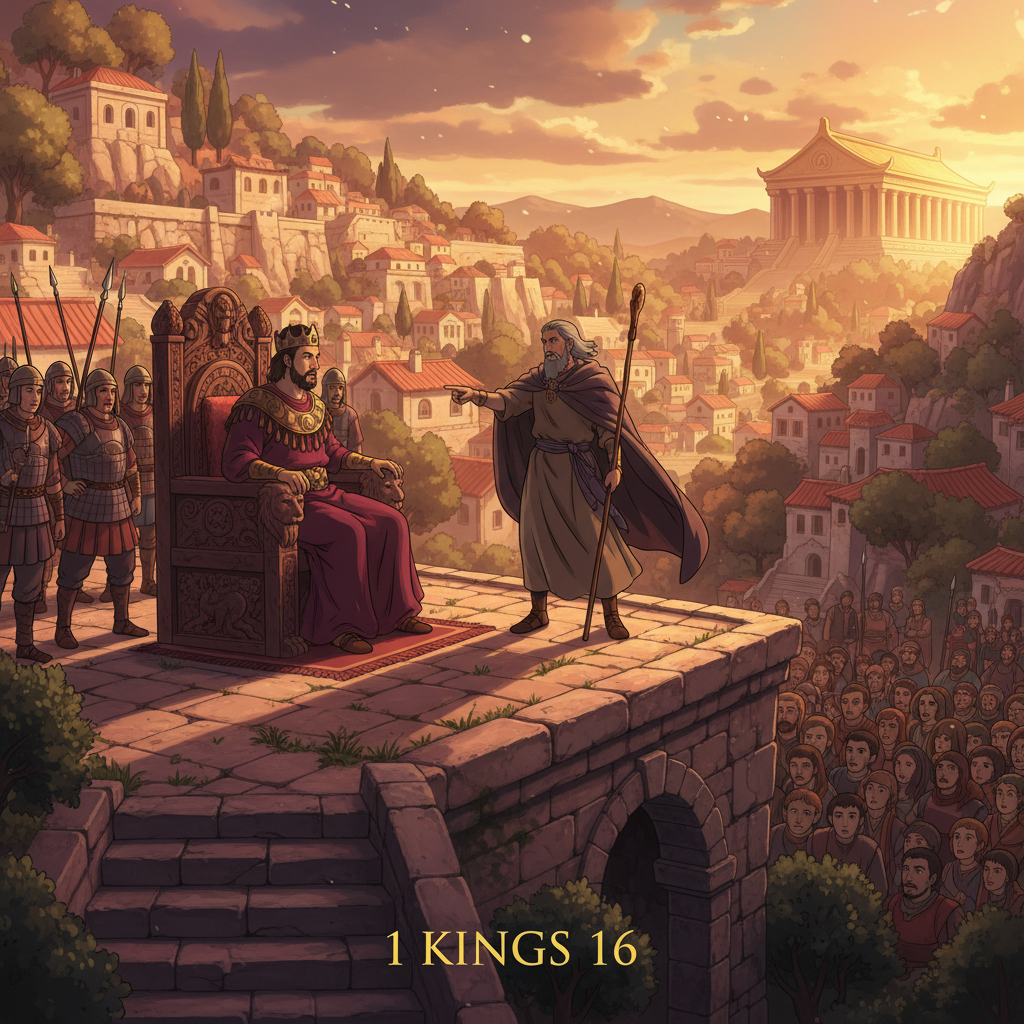
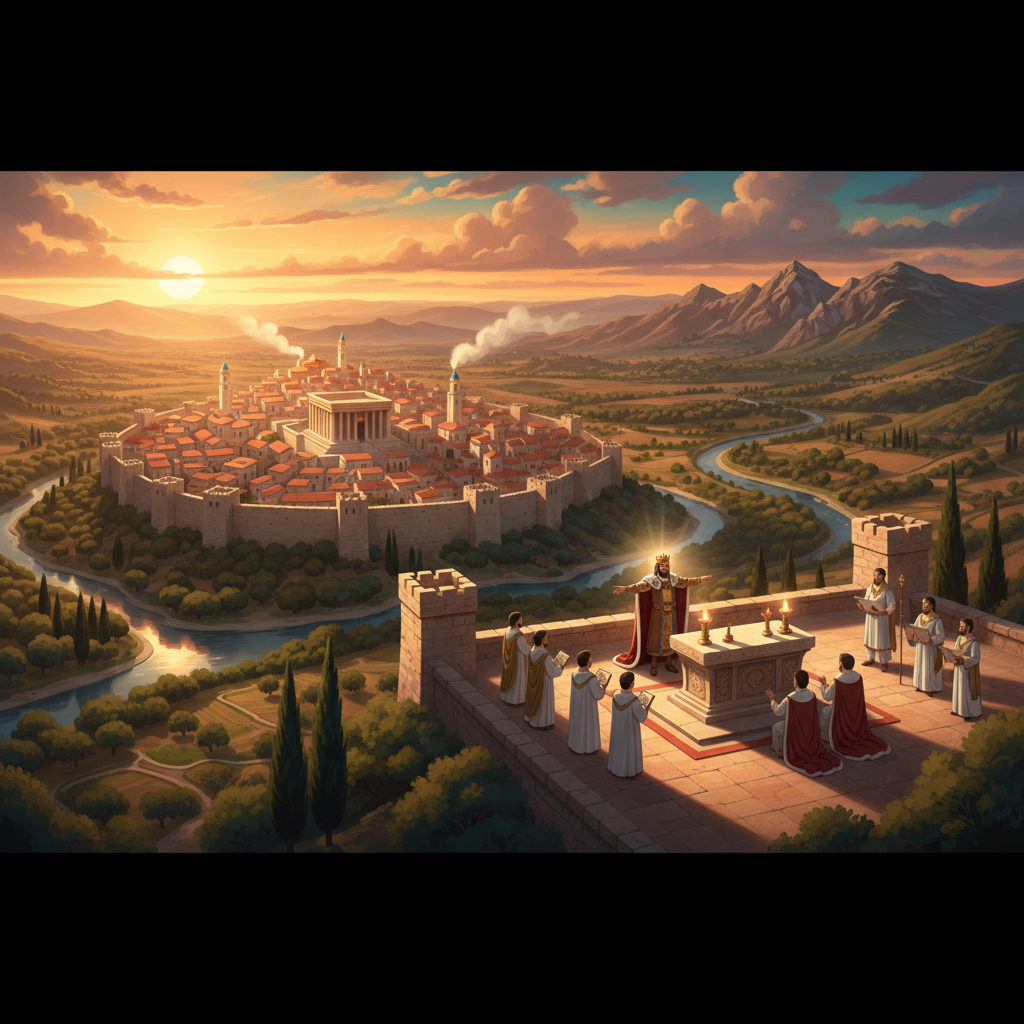
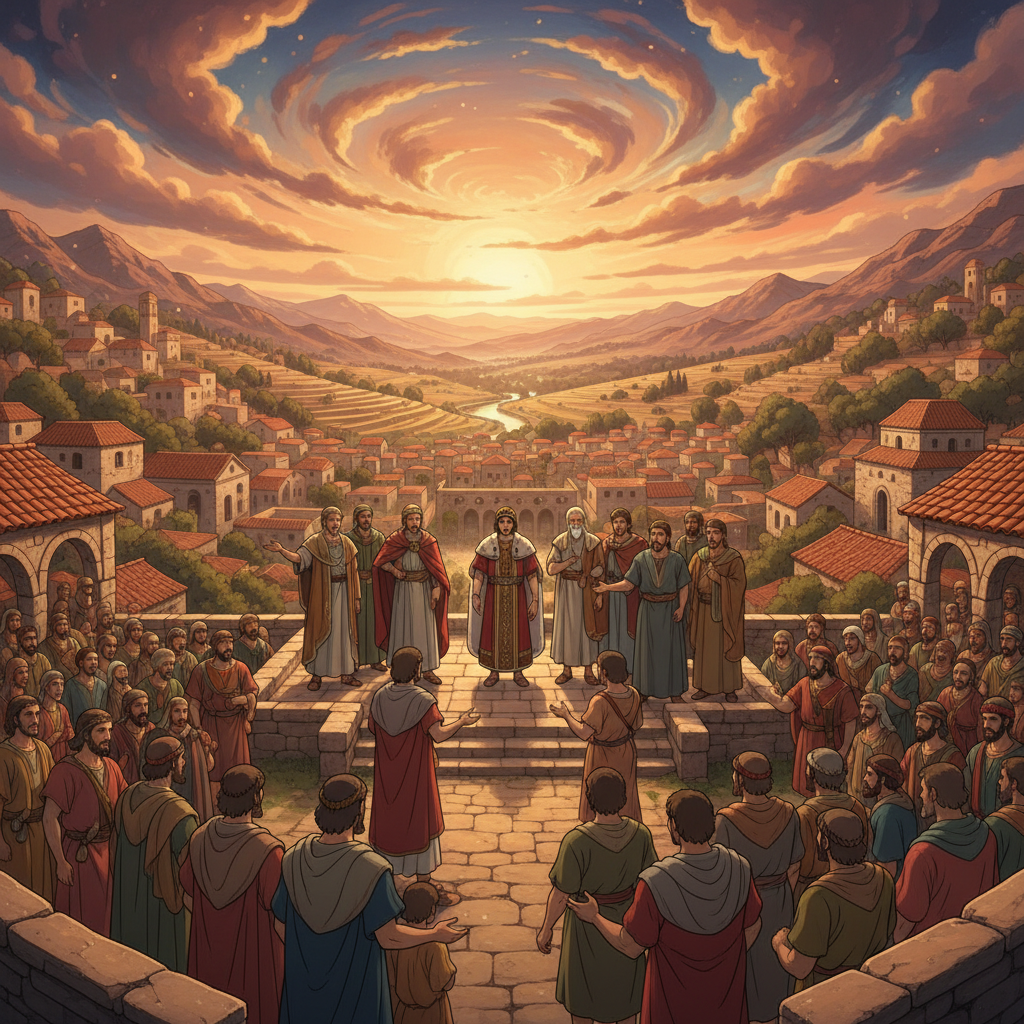
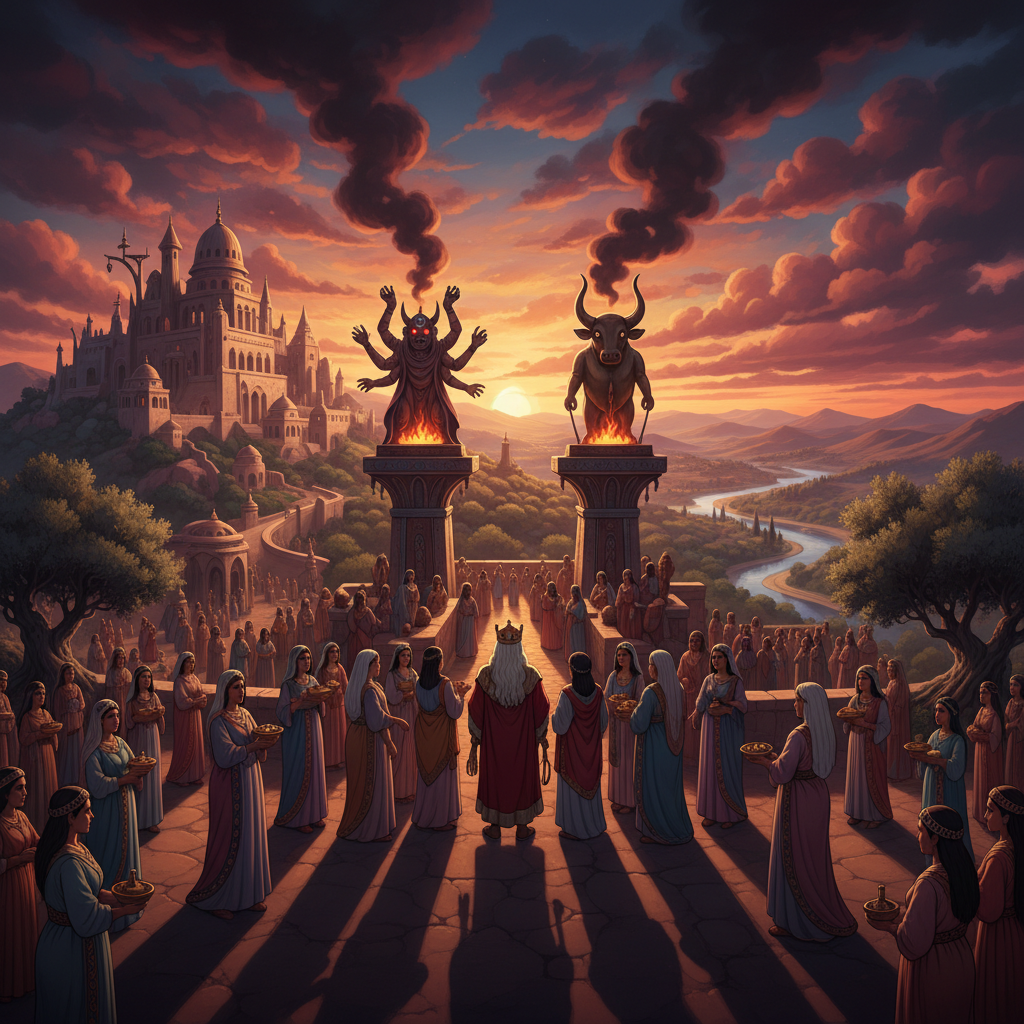
1 Kings chapter 16 tells us about several kings of Israel. Most of them did evil in the sight of the Lord. This chapter shows what happens when leaders choose sin instead of obeying God. First, God se...
1 Kings 16
February 17, 2026

1 Kings 16: The Royal Succession of Israel

1 Kings chapter 16 tells us about several kings of Israel. Most of them did evil in the sight of the Lord. This chapter shows what happens when leaders choose sin instead of obeying God. First, God sent a message through a prophet named Jehu to King Baasha. God reminded Baasha that He had allowed him to become king. But Baasha did evil and led Israel into sin, just like Jeroboam had done. Because of this, God said Baasha’s family would be destroyed. After Baasha died, his son Elah became king of Israel. Elah ruled for only two years. While he was drinking and getting drunk in the house of one of his officers, a commander named Zimri attacked him and killed him. Zimri then became king. When Zimri became king, he killed all the members of Baasha’s family. This fulfilled the message God had given through the prophet. However, Zimri also did evil in the sight of the Lord. His rule did not last long. The army of Israel heard that Zimri had killed the king, so they made their army commander, Omri, king instead. Omri and his army attacked Zimri in the city of Tirzah. When Zimri saw that he was losing, he went into the king’s palace and set it on fire around himself. He died in the fire after ruling for only seven days. This shows how unstable and violent the kingdom had become because of sin. After this, the people of Israel were divided. Some followed Omri, and others followed a man named Tibni. After some time, Omri became stronger and ruled the whole kingdom. Omri did more evil than all the kings before him. He continued in the sinful ways of Jeroboam. Omri built a new capital city called Samaria. After Omri died, his son Ahab became king. Ahab did even more evil than his father. He married Jezebel and worshipped Baal, a false god. He built a temple for Baal and led Israel far away from the true God. Because of this, God was greatly displeased. This chapter teaches us that when leaders do not follow God, there is confusion, violence, and trouble. It also shows that sin leads to serious consequences. God sees everything and judges rightly.

1 Kings chapter 15 talks about different kings who ruled in Judah and Israel after King Solomon. The kingdom was divided into two parts. Judah was in the south, and Israel was in the north. First, we ...
1 Kings 15
February 16, 2026

1 Kings 15: The Royal Succession of Judah

1 Kings chapter 15 talks about different kings who ruled in Judah and Israel after King Solomon. The kingdom was divided into two parts. Judah was in the south, and Israel was in the north. First, we read about King Abijam of Judah. He ruled for three years in Jerusalem. The Bible says he did not fully obey God. He followed the wrong example of his father. Even though he was not faithful, God allowed his son to become king after him because of the promise God had made to King David. God always keeps His promises. After Abijam died, his son Asa became king. Asa was a good king. He did what was right in the eyes of the Lord. He removed idols and destroyed places where people worshipped false gods. He even removed his grandmother from her important position because she had made an idol. Asa wanted the people to worship only the true God. However, not every high place was removed. Asa ruled for many years and tried to lead the people well. In Israel, Nadab, the son of Jeroboam, became king. He did evil in God’s sight and continued in sin. A man named Baasha killed Nadab and destroyed Jeroboam’s family. This happened because God had warned that Jeroboam’s family would be punished for leading Israel into sin. Baasha then became king, but he also did evil. There was war between Asa, king of Judah, and Baasha, king of Israel. Asa made an agreement with the king of Syria for help. In the end, Baasha stopped his plans against Judah. This chapter teaches us that leaders must choose to obey God. When leaders do wrong, the people suffer. It also teaches that God keeps His promises and that sin brings consequences.

1 Kings Chapter 14 tells us about the results of sin and the importance of listening to God. It shows what happened in both the northern kingdom of Israel and the southern kingdom of Judah. At the beg...
1 Kings 14
February 15, 2026

1 Kings 14: Sin in the Northern and Southern Kingdoms

1 Kings Chapter 14 tells us about the results of sin and the importance of listening to God. It shows what happened in both the northern kingdom of Israel and the southern kingdom of Judah. At the beginning of the chapter, Jeroboam’s son, Abijah, became very sick. Jeroboam was worried, so he told his wife to disguise herself and go to the prophet Ahijah. Ahijah was the prophet who had earlier told Jeroboam that he would become king over ten tribes of Israel. Jeroboam hoped the prophet would tell them if the child would get better. Jeroboam’s wife dressed like an ordinary woman so the prophet would not recognize her. She took gifts and went to Ahijah’s house. By this time, Ahijah was old and blind. But God had already told Ahijah that Jeroboam’s wife was coming and what message to give her. When Jeroboam’s wife arrived, Ahijah called her by name. He told her that because Jeroboam had led Israel into sin by worshipping idols, terrible things would happen to his family. God said that Jeroboam’s family line would be destroyed. The prophet also said that the sick child would die when she returned home, but the child would be buried peacefully because he was the only one in Jeroboam’s family who pleased the Lord. As soon as Jeroboam’s wife returned home and stepped into the city, the child died, just as the prophet had said. This showed that God’s word always comes true. The chapter then tells us about the rest of Jeroboam’s life. He ruled Israel for twenty-two years. When he died, his son Nadab became king. Jeroboam is remembered as a king who led Israel into sin. The chapter also speaks about what was happening in Judah under King Rehoboam. The people of Judah also began to sin against God. They built high places and worshipped idols. Because of their sin, King Shishak of Egypt attacked Jerusalem. He took treasures from the temple and from the king’s palace. Rehoboam had to replace the gold shields with bronze ones, which were not as valuable. This showed how the kingdom was becoming weaker. Rehoboam ruled for seventeen years. When he died, his son Abijam became king. This chapter teaches us that sin has serious consequences. God is patient, but He is also just. It also reminds us that God sees everything, even when people try to hide the truth. Lesson from the Chapter We cannot hide from God. Obedience brings blessing, but sin brings trouble.

1 Kings Chapter 12 tells us how the kingdom of Israel became divided into two parts. This happened after King Solomon died and his son Rehoboam became king. All the people of Israel went to a place ca...
1 Kings 12
February 13, 2026

1 Kings 12: Israel is Divided

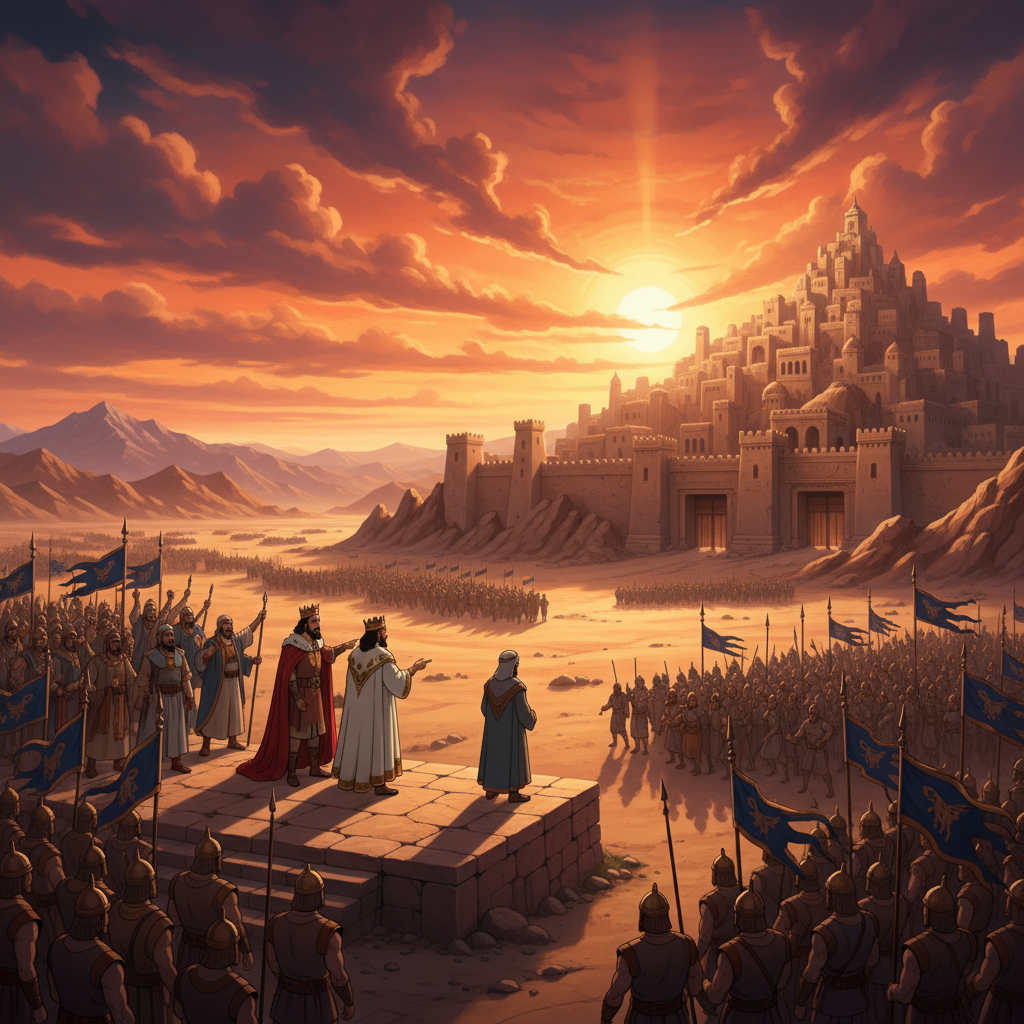
1 Kings Chapter 12 tells us how the kingdom of Israel became divided into two parts. This happened after King Solomon died and his son Rehoboam became king. All the people of Israel went to a place called Shechem to make Rehoboam king. Jeroboam also returned from Egypt. The people came to Rehoboam with a request. They said that Solomon had made their work very hard and had placed heavy taxes on them. They asked Rehoboam to make their work easier, and they promised to serve him faithfully if he did. Rehoboam told them to come back in three days for his answer. First, he asked the older men who had advised his father Solomon. These wise elders told him to be kind to the people. They said if he spoke gently and reduced their heavy load, the people would serve him gladly. But Rehoboam did not follow their advice. Instead, he asked the young men who had grown up with him. They told him to be strict and strong. They said he should tell the people that he would make their work even harder than Solomon did. They told him to show his power. After three days, the people returned. Rehoboam answered them harshly. He said his father had punished them with whips, but he would punish them with scorpions, which meant even greater suffering. He refused to make their burden lighter. When the people heard this, they became angry. They said they no longer wanted David’s family to rule over them. Ten tribes of Israel chose Jeroboam as their king. Only the tribes of Judah and Benjamin stayed with Rehoboam. From that time, the kingdom was divided into two parts. The northern kingdom was called Israel and was ruled by Jeroboam. The southern kingdom was called Judah and was ruled by Rehoboam. Rehoboam gathered soldiers to fight and bring the kingdom back together. But God sent a prophet named Shemaiah with a message. God told Rehoboam not to fight against his brothers because the division was part of His plan. So Rehoboam and the people obeyed and did not go to war. Jeroboam became king over Israel, but he made a serious mistake. He was afraid the people would go to Jerusalem in Judah to worship at the temple. He thought their hearts might turn back to Rehoboam. So he made two golden calves and told the people that these were the gods who brought them out of Egypt. He placed one calf in Bethel and the other in Dan. He built places of worship and chose priests who were not from the tribe of Levi. He even made his own festival days. This was a great sin. Jeroboam led the people away from worshiping the true God. Because of this, many problems would come later. This chapter teaches us that leaders must listen to wise advice and be humble. It also teaches that fear can cause people to make wrong choices. When we turn away from God’s truth, it brings trouble. Lesson from the Chapter Wise advice and obedience to God are very important. Pride and fear can lead to serious mistakes.

Solomon had many wives. Many of them were from other nations. God had told the Israelites not to marry people from nations that worshipped false gods, because those marriages could lead them away from...
1 Kings 11
February 12, 2026

1 Kings 11: Solomon's Wives

Solomon had many wives. Many of them were from other nations. God had told the Israelites not to marry people from nations that worshipped false gods, because those marriages could lead them away from Him. But Solomon did not obey this command. He loved many foreign women, and he married hundreds of wives and had many other women in his palace. As Solomon grew older, his wives influenced him to worship their gods. His heart slowly turned away from the Lord. He built high places, which were special places of worship, for false gods like Chemosh and Molech. Instead of being fully devoted to God like his father David, Solomon began to follow other gods. This made God very angry. God had appeared to Solomon twice and clearly told him to obey His commands. But Solomon did not listen. Because of this, God said that the kingdom would be taken away from Solomon’s family. However, for David’s sake, God said this would not happen during Solomon’s lifetime. Instead, the kingdom would be divided after his death. One tribe would remain under Solomon’s son, but the rest would be separated. God raised up enemies against Solomon. One enemy was Hadad from Edom. Another was Rezon from Syria. These men caused trouble for Israel. There was also a man named Jeroboam. He was one of Solomon’s workers. A prophet told Jeroboam that he would one day rule over ten tribes of Israel because of Solomon’s disobedience. When Solomon heard this, he tried to kill Jeroboam, but Jeroboam escaped to Egypt and stayed there until Solomon died. Solomon ruled Israel for forty years. When he died, his son Rehoboam became king. This chapter teaches us that even wise people can make wrong choices if they stop listening to God. It shows that obedience is important throughout our whole life. Turning away from God brings serious consequences. Lesson from the Chapter We must stay faithful to God all our lives. Wisdom and blessings mean nothing if we turn away from Him.

1 Kings Chapter 10 tells us about the great wisdom and wealth of King Solomon. It also tells the story of the Queen of Sheba visiting him. The Queen of Sheba heard about Solomon’s wisdom and the famou...
1 Kings 10
February 11, 2026

1 Kings 10: The Wisdom and Wealth of Solomon

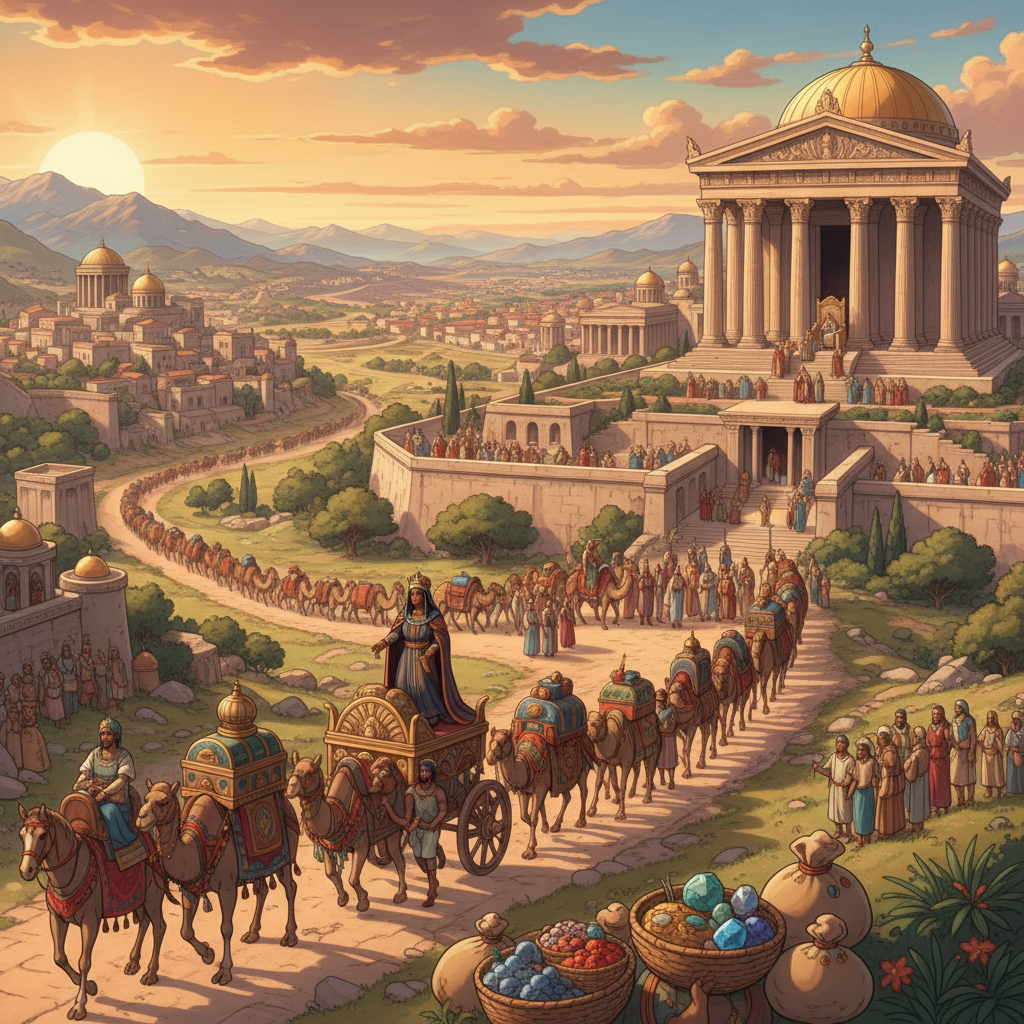
1 Kings Chapter 10 tells us about the great wisdom and wealth of King Solomon. It also tells the story of the Queen of Sheba visiting him. The Queen of Sheba heard about Solomon’s wisdom and the famous temple he built for the Lord. She wanted to see for herself if the stories were true. So she traveled a very long way to Jerusalem. She brought many gifts with her, including spices, gold, and precious stones. When she arrived, she asked Solomon many hard questions. The Bible says that Solomon answered all her questions. There was nothing too difficult for him to explain. The Queen of Sheba was amazed at his wisdom. She also saw his beautiful palace, the food on his table, the way his servants worked, and the way people worshipped in the temple. Everything was well organized and wonderful. She told Solomon that what she had heard about him was true, but she did not believe it until she saw it with her own eyes. She said that not even half of his greatness had been told to her. She praised the Lord for giving Israel such a wise king. She gave Solomon many gifts, and Solomon also gave her royal gifts before she returned to her country. The chapter also describes how rich Solomon was. He received a large amount of gold every year. He made shields of gold and decorated his palace with gold. His throne was made of ivory and covered with gold. It had six steps and lions carved beside it. It was very grand and beautiful. Solomon had many ships that brought gold, silver, ivory, apes, and peacocks from faraway lands. He became richer and wiser than all the kings of the earth. Many kings and leaders came to listen to his wisdom and brought him gifts. However, while the chapter shows Solomon’s greatness, it also reminds us that wealth and success come from God. God was the One who gave Solomon wisdom. Without God, Solomon would not have been so great. Lesson from the Chapter True wisdom and success come from God. When God blesses someone, others can see it. We should always thank God for our talents and achievements.

1 Kings Chapter 9 tells us how God appeared to Solomon after the temple and the palace were finished. This chapter teaches us about God’s promises, obedience, and the results of our choices. After Sol...
1 Kings 9
February 10, 2026

1 Kings 9: Solomon is visited by GOD and receives a Promise

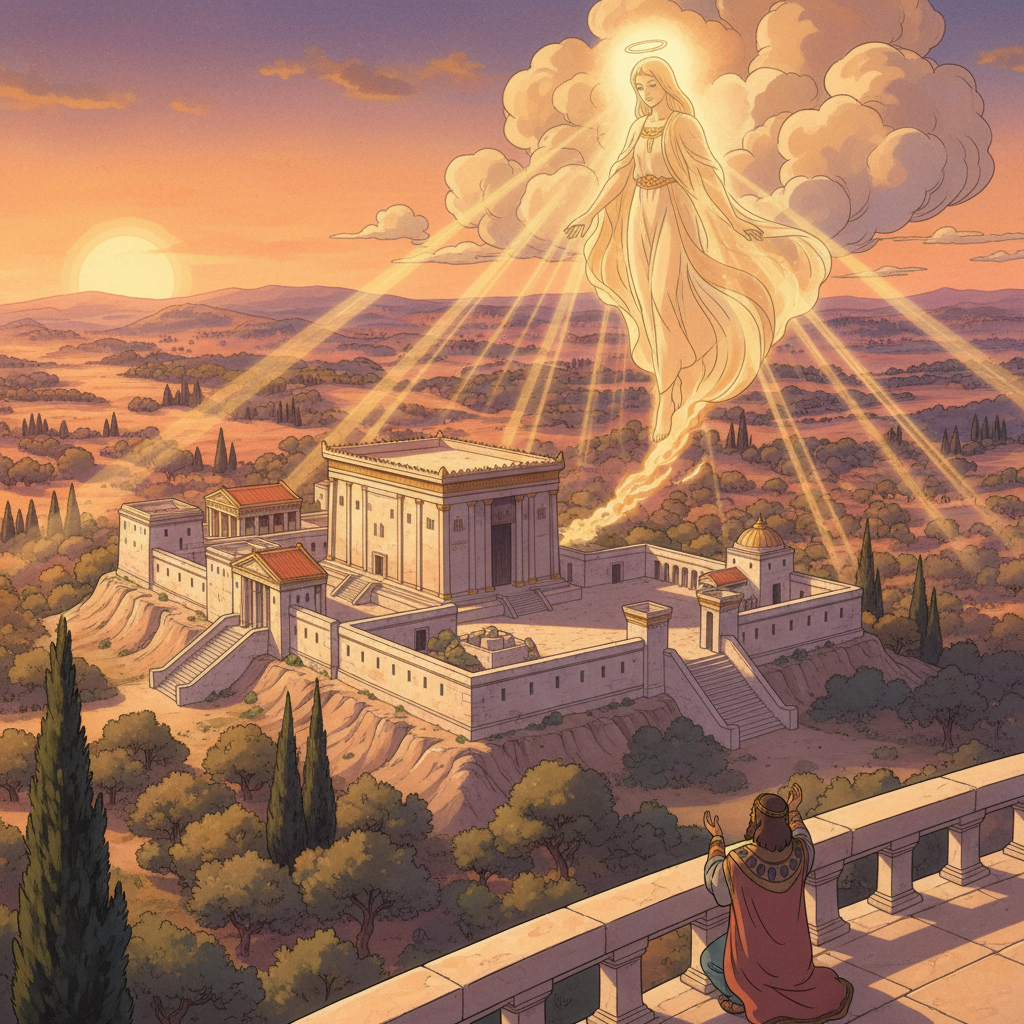
1 Kings Chapter 9 tells us how God appeared to Solomon after the temple and the palace were finished. This chapter teaches us about God’s promises, obedience, and the results of our choices. After Solomon finished building the temple of the Lord and the royal palace, God appeared to him a second time. God told Solomon that He had heard his prayer and accepted the temple as a special place where people could pray and worship. God promised that His presence would always be in the temple. God then made a clear promise to Solomon. He said that if Solomon and his children obeyed Him, followed His commands, and walked in His ways, God would keep Solomon’s family on the throne of Israel. This promise was connected to the promise God made earlier to David. However, God also gave a warning. He said that if Solomon or the people turned away from Him, worshipped other gods, and disobeyed His commands, there would be serious consequences. God said the kingdom would suffer, and the temple could be destroyed. People from other nations would see this and ask why such a great temple was ruined. The answer would be because the people stopped obeying God. The chapter also talks about Solomon’s other achievements. Solomon gave King Hiram of Tyre twenty towns in Galilee as a gift for helping him with building materials. However, King Hiram was not pleased with the towns. Solomon continued to build cities, strengthen Israel, and organize his kingdom. He used workers to build roads, cities, and storehouses. He also made sure that sacrifices were offered to God regularly at the temple during special holy days. This chapter reminds us that God blesses obedience, but disobedience brings trouble. God keeps His promises, but He also expects His people to remain faithful. *Lesson from the Chapter* God wants us to obey Him with our whole hearts. Blessings come when we follow God, but turning away from Him brings problems. *

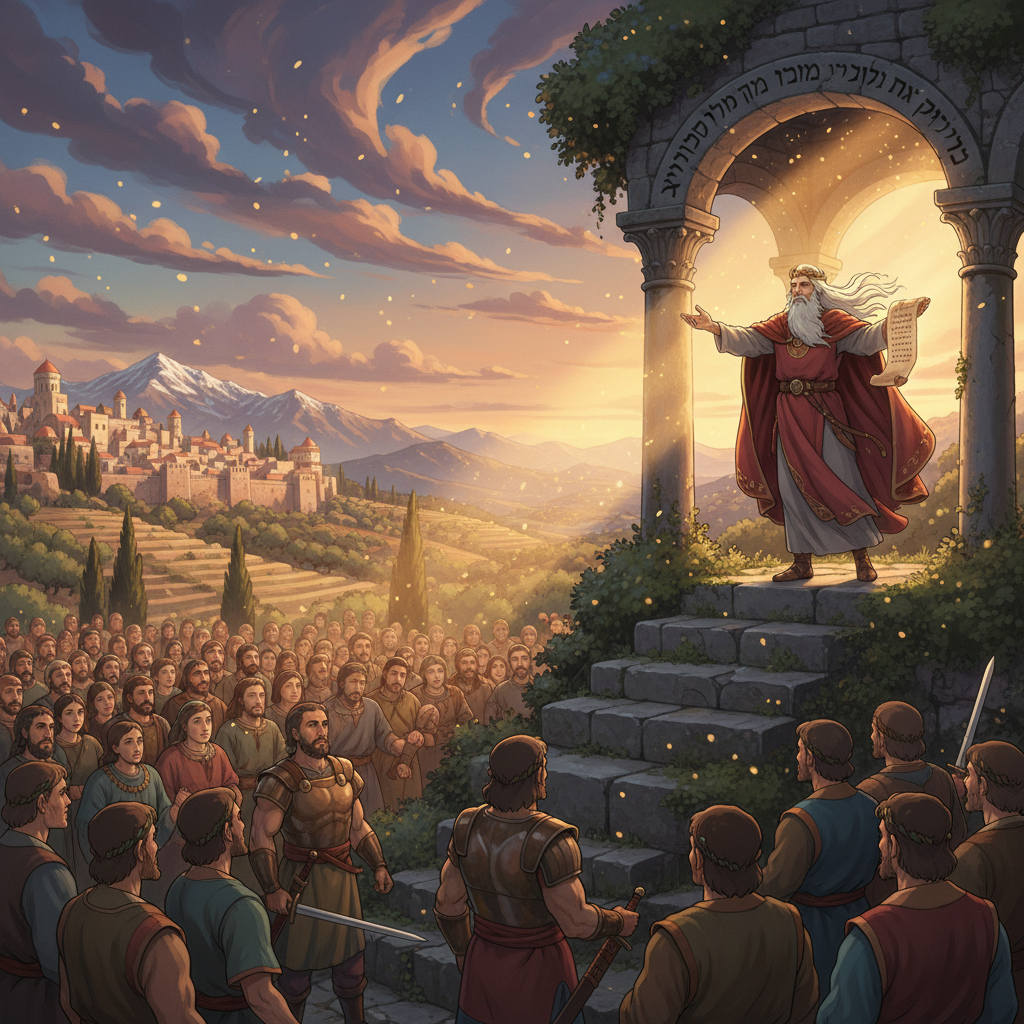
1 Kings Chapter 8 tells us about the special day when the temple was opened and dedicated to God. This was a very joyful and holy moment for the people of Israel. The chapter teaches us about worship,...
1 Kings 8
February 9, 2026

1 Kings 8: Solomon dedicates the Temple in Jerusalem

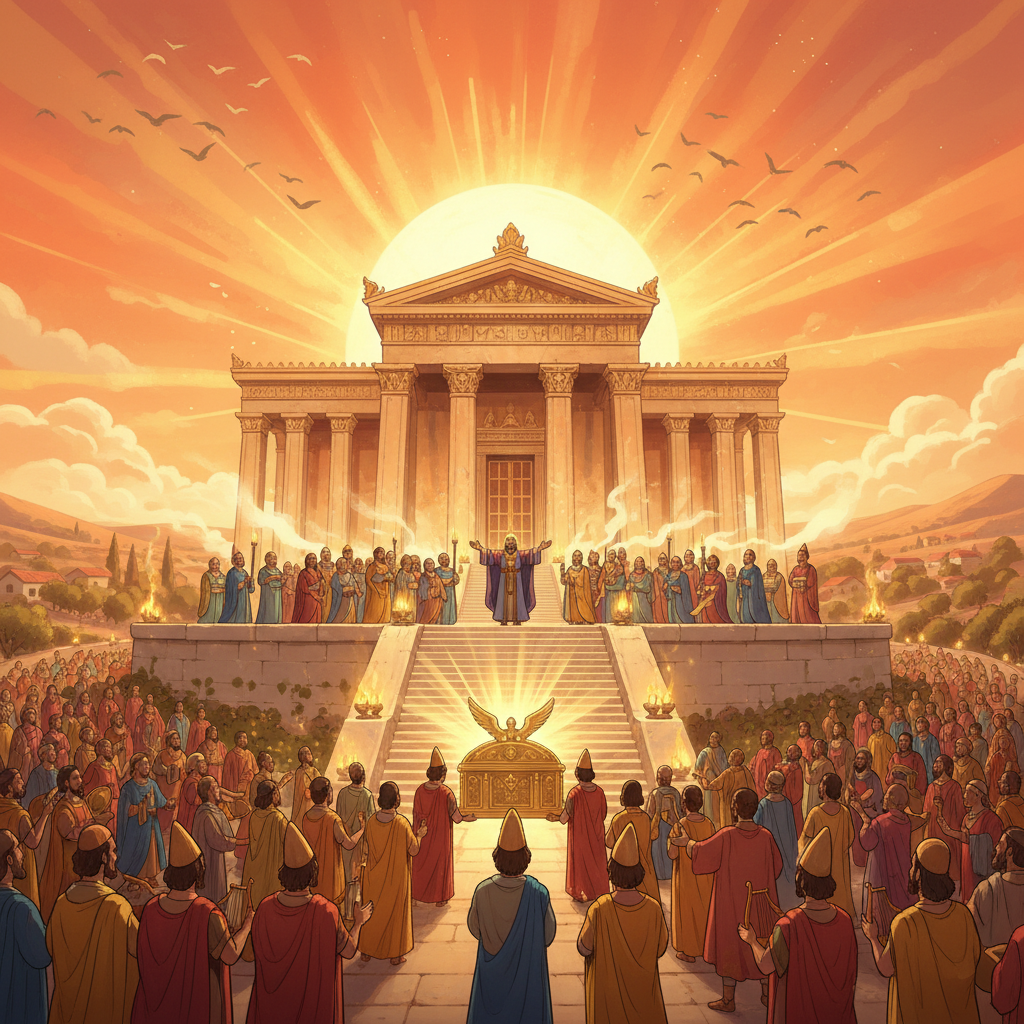
1 Kings Chapter 8 tells us about the special day when the temple was opened and dedicated to God. This was a very joyful and holy moment for the people of Israel. The chapter teaches us about worship, prayer, and God’s faithfulness. After the temple was finished, Solomon called all the leaders of Israel to Jerusalem. The priests brought the Ark of the Covenant into the temple. The Ark was very important because it reminded the people of God’s promise and His presence with them. The priests carried the Ark into the Most Holy Place, the inner room of the temple. When they came out, a thick cloud filled the temple. This cloud showed that God’s presence had come into the temple. The priests could not continue their work because the glory of the Lord filled the house. This was a powerful sign that God accepted the temple. Solomon then stood before the people and praised God. He said that God had kept His promise to David. God had said that David’s son would build the temple, and now it was complete. Solomon reminded the people that God always keeps His promises. After this, Solomon prayed a long and beautiful prayer. He stood before the altar, lifted his hands toward heaven, and prayed. He thanked God for His faithfulness and asked Him to listen to the prayers of the people. Solomon knew that God is too great to be contained in a building. He said that even the highest heavens cannot hold God, so the temple was simply a special place for prayer and worship. Solomon asked God to forgive the people when they sinned and turned back to Him. He prayed that God would hear their prayers during hard times such as famine, war, sickness, or trouble. He also prayed for foreigners who would come to worship God, asking that God would hear them too. After the prayer, Solomon blessed the people and reminded them to remain faithful to God. He encouraged them to obey God’s commands and walk in His ways. Then the people offered many sacrifices and celebrated for several days. It was a time of joy and thanksgiving. After the celebration, everyone returned home happy and thankful for God’s goodness. This chapter teaches us that God keeps His promises, listens to our prayers, and forgives when we repent. It also shows us the importance of worship and obedience.

1 Kings Chapter 7 tells us about the buildings Solomon made after finishing the temple and the special items that were prepared for God’s house. This chapter teaches us about patience, skill, and givi...
1 Kings 7
February 8, 2026

1 Kings 7: Building King Solomon's Palace

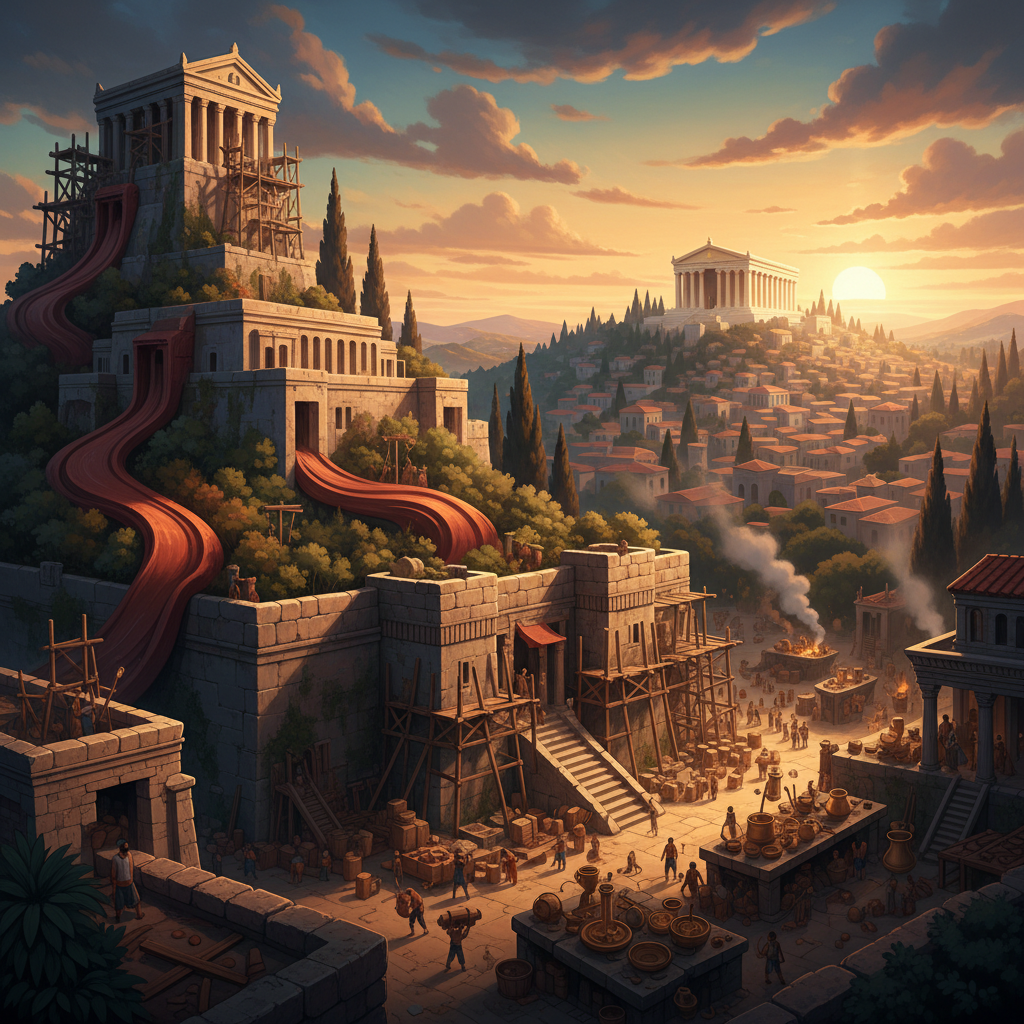
1 Kings Chapter 7 tells us about the buildings Solomon made after finishing the temple and the special items that were prepared for God’s house. This chapter teaches us about patience, skill, and giving careful attention to God’s work. After Solomon finished building the temple, he began building his own palace. The palace took much longer to complete than the temple. It took thirteen years. This shows that Solomon took time to carefully plan and build strong and beautiful buildings. Solomon built several important buildings as part of the palace. One was called the Palace of the Forest of Lebanon. It was made with many cedar pillars and looked like a forest of trees inside. Another building was the Hall of Pillars, which was used for important meetings. There was also a Hall of Judgment, where Solomon sat to make fair decisions and settle problems among the people. Solomon also built a house for Pharaoh’s daughter, whom he had married. This shows that Solomon made sure everyone in his household had a place to live. The chapter then talks about a skilled worker named Hiram, who was different from King Hiram of Tyre. This Hiram was a craftsman who was very good at working with bronze. Solomon asked him to make special items for the temple. Hiram made two tall bronze pillars for the front of the temple. These pillars were named Jakin and Boaz. They stood as symbols of strength and stability. He also made a large bronze bowl called the Sea. It was filled with water and used by the priests for washing. The Sea rested on twelve bronze bulls. Hiram also made many smaller items such as pots, shovels, and bowls, all made of bronze. Everything was carefully made and placed in the temple. At the end of the chapter, the Bible tells us that Solomon brought into the temple the gifts that his father David had dedicated to God. These included silver, gold, and special treasures. Solomon made sure everything was prepared properly for worship. This chapter teaches us that God’s work should be done with care and skill. It also shows that patience and attention to detail are important when serving God.

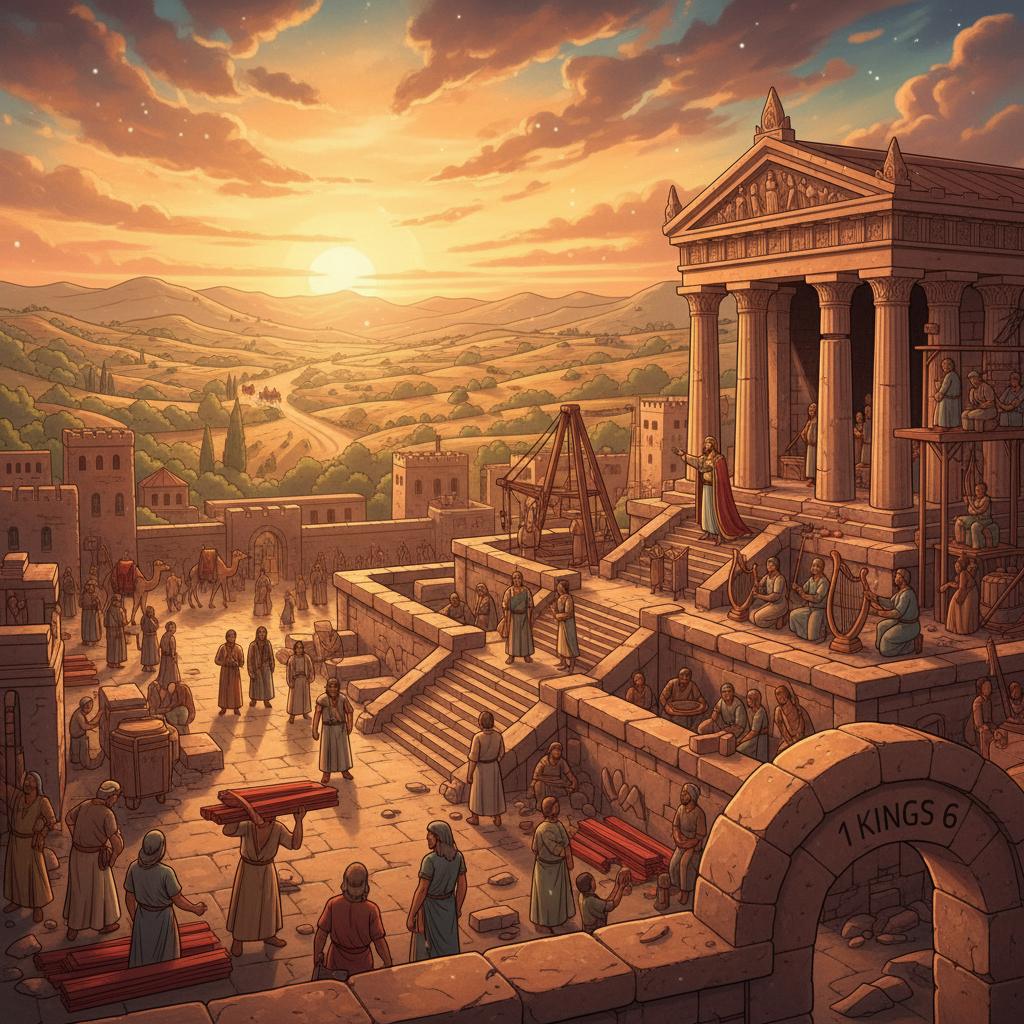
1 Kings Chapter 6 tells us about the building of the temple in Jerusalem. This was one of the most important events in Israel’s history. The temple was a special house built to honor God. This chapter...
1 Kings 6
February 7, 2026

1 Kings 6: Building the Temple in Jerusalem

1 Kings Chapter 6 tells us about the building of the temple in Jerusalem. This was one of the most important events in Israel’s history. The temple was a special house built to honor God. This chapter teaches us about obedience, careful work, and giving our best to God. The chapter begins by telling us when the building started. It was four hundred and eighty years after the Israelites left Egypt. Solomon began building the temple in the fourth year of his reign as king. This shows that God’s promises take time, but they are always fulfilled. The temple was built on Mount Moriah in Jerusalem. The Bible gives many details about its size and design. The temple was not very large compared to modern buildings, but it was beautiful and carefully made. It had three main parts: the outer area, the Holy Place, and the Most Holy Place. The Most Holy Place was the most sacred room. It was where the Ark of the Covenant would be placed. The walls were made of stone, but the inside was covered with cedar wood. The wood was carved with pictures of flowers, palm trees, and angels called cherubim. Then the walls were covered with pure gold. The floor was also covered with gold. Everything inside the temple showed beauty and honor for God. God spoke to Solomon during the building. God reminded Solomon that the most important thing was obedience. God said that if Solomon obeyed His commands, He would live among His people and keep His promise to David. This shows that a building is not as important as having a faithful heart. The chapter also explains how carefully the temple was built. The stones were cut and shaped at the quarry. At the building site, there was no sound of hammer or tools. This showed respect and careful planning. It took seven years to complete the temple. Solomon made sure everything was done according to the plan. The temple was not built quickly. It was built with patience and care. This chapter teaches us that God deserves our best. It also reminds us that obeying God is more important than beautiful buildings. God wants our hearts to be faithful and pure.

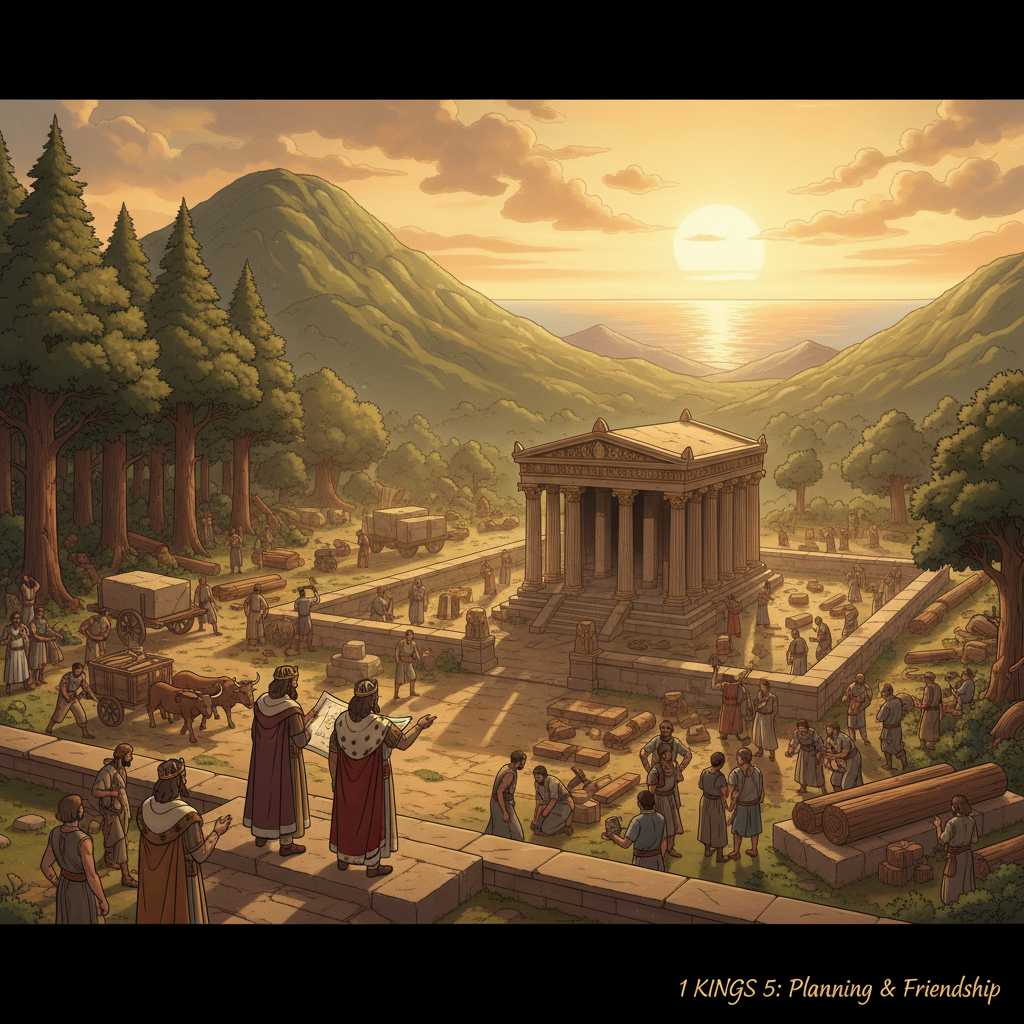
1 Kings Chapter 5 tells us how Solomon prepared to build the temple for the Lord. This chapter teaches us about planning, teamwork, friendship, and honoring God. After Solomon became king and his king...
1 Kings 5
February 6, 2026

1 Kings 5: Planning the Temple in Jerusalem

1 Kings Chapter 5 tells us how Solomon prepared to build the temple for the Lord. This chapter teaches us about planning, teamwork, friendship, and honoring God. After Solomon became king and his kingdom was peaceful, he decided to build a temple for God. His father, King David, had wanted to build the temple, but God told him that his son would do it instead. Now the time had come for Solomon to begin this important work. Hiram, the king of Tyre, had been a friend of David. When Hiram heard that Solomon was now king, he sent a message of friendship. Solomon replied and told Hiram about his plan to build the temple. He explained that David could not build the temple because of the many wars he had fought. But now there was peace in the land, and Solomon wanted to build a house for the name of the Lord. Solomon asked Hiram to help by providing cedar wood from Lebanon. The trees in Lebanon were strong and tall, perfect for building. Hiram was pleased to help. He agreed to send wood by sea to Israel. In return, Solomon promised to send food supplies to Hiram’s household. This agreement brought peace and cooperation between the two kings. The Bible says that the Lord gave Solomon wisdom, just as He had promised. Because of this wisdom, Solomon was able to make good plans and build strong friendships with other nations. Solomon organized many workers to prepare the materials. He sent thousands of men to Lebanon to cut wood. They worked in shifts so they could also spend time at home. He also had many workers cutting stone from the mountains. Large stones were prepared carefully to serve as the foundation of the temple. The builders shaped the stones and wood at the quarry so that when they were brought to the building site, everything fit together quietly. This showed careful planning and respect for God’s house. This chapter teaches us that serving God requires preparation and teamwork. It also shows that peace and wisdom help great work to be done.

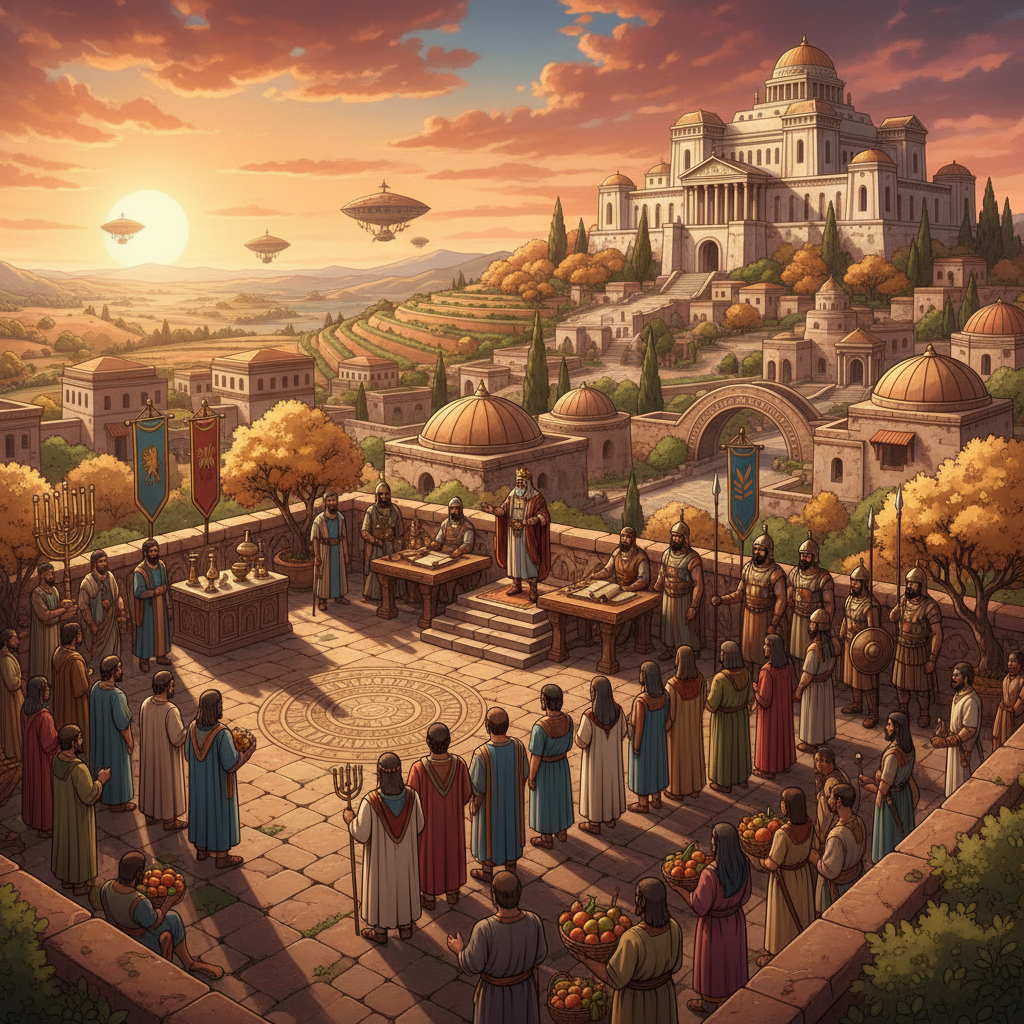
1 Kings Chapter 4 tells us how King Solomon organized his kingdom and how wise and successful his rule became. This chapter teaches us that good leadership includes order, wisdom, peace, and care for ...
1 Kings 4
February 5, 2026

Solomon's Kingdom: Wisdom and Peace

1 Kings Chapter 4 tells us how King Solomon organized his kingdom and how wise and successful his rule became. This chapter teaches us that good leadership includes order, wisdom, peace, and care for the people. The chapter begins by listing the important officials who worked with King Solomon. These included priests, secretaries, record keepers, army leaders, and governors. Each person had a special job to help the kingdom run smoothly. This shows that Solomon did not rule alone. He worked with others and shared responsibilities. Solomon divided Israel into twelve districts. Each district had a governor who was in charge of providing food and supplies for the king and his household. Each governor was responsible for one month of the year. This system helped make sure that everyone shared the work fairly and that there was always enough food for the king and his large household. The chapter also describes how large and prosperous Solomon’s kingdom was. There was plenty of food, and the people of Judah and Israel lived safely and happily. The Bible says they ate, drank, and rejoiced. This shows that during Solomon’s reign, there was peace and joy in the land. Solomon ruled over a very large area, from the Euphrates River to the land of the Philistines and to the border of Egypt. Many surrounding nations respected Solomon and paid tribute to him. This means they brought gifts and showed honor to him because of his great power and wisdom. The chapter then talks about Solomon’s great wisdom. God gave Solomon wisdom that was greater than that of all the wise men around him. Solomon spoke many wise sayings and taught people about nature, plants, animals, birds, and fish. People from many lands came to hear Solomon’s wisdom. The chapter ends by reminding us that Solomon had peace on all sides. There were no major wars, and the people felt safe. This peace was a blessing from God and a result of wise leadership. This chapter teaches us that when leaders use wisdom and organize well, people can live in peace and happiness. It also shows that wisdom is a gift from God that should be used to help others.

2 Samuel Chapter 23 talks about two important things. First, it shares the last words of King David. Second, it tells us about David’s mighty warriors, who were brave men that helped him protect and l...
2 Samuel 23
January 31, 2026

2 Samuel 23: David's Last Words and Mighty Warriors

2 Samuel Chapter 23 talks about two important things. First, it shares the last words of King David. Second, it tells us about David’s mighty warriors, who were brave men that helped him protect and lead Israel. This chapter teaches us about strong faith, good leadership, courage, and loyalty. The chapter begins with David’s last words. These words are not just goodbye words. They are wise teachings and praises to God. David explains that God chose him to be king and helped him rule the people fairly. David says that a good ruler should rule with justice and fear God. When a leader obeys God, the people live in peace and blessing. David also talks about God’s promise to his family. God had promised that David’s family line would continue. This promise was very important because it showed that God keeps His word. David trusted God’s promise even when his life was not always easy. The chapter then talks about David’s mighty men. These were very brave soldiers who helped David win battles and protect Israel. The Bible lists their names and tells us about their great acts of courage. Three of the most famous mighty men were Josheb-Basshebeth, Eleazar, and Shammah. One of them fought and defeated many enemies by himself. Another one stood his ground and did not run away even when others fled. Their bravery showed strong faith and loyalty. There is also a story about three mighty men who risked their lives to bring David water from Bethlehem. David had said he wished for water from a certain well, and these men broke through enemy lines to get it. When they brought it to David, he refused to drink it because he felt it was too precious. Instead, he poured it out to God as an offering. This showed David’s respect for God and his care for his men. The chapter ends by naming more mighty warriors and honoring their service. These men were not famous kings, but God made sure their names were remembered because of their faithfulness and courage. This chapter teaches us that God values leaders who obey Him and people who are loyal, brave, and willing to serve others.

2 Samuel 10 teaches us about kindness, misunderstanding, and how pride can lead to trouble. This chapter shows what happened when a good intention was wrongly judged and turned into a war. The chapter...
2 Samuel 10
January 18, 2026

2 Samuel 10: The Shaved Beards and a Costly Mistrust

2 Samuel 10 teaches us about kindness, misunderstanding, and how pride can lead to trouble. This chapter shows what happened when a good intention was wrongly judged and turned into a war. The chapter begins with the death of the king of the Ammonites. His son, Hanun, became the new king. David remembered how kind Hanun’s father had been to him in the past. Because of this, David decided to show kindness to Hanun by sending messengers to comfort him after his father’s death. However, the Ammonite leaders did not trust David’s kindness. They told King Hanun that David’s men were not there to help, but to spy on the land and prepare for attack. Hanun believed them and made a very bad decision. Hanun treated David’s messengers with great disrespect. He shaved off half of their beards and cut their clothes, leaving them ashamed. This was a serious insult in those days. When David heard what happened, he told his men to stay in another town until their beards grew back, so they would not feel embarrassed. The Ammonites realized they had made David angry. They became afraid and hired soldiers from other nations, including the Syrians, to help them fight against Israel. Joab, the commander of David’s army, led Israel’s soldiers into battle. Joab saw that the enemy was coming from two directions. He made a wise plan and trusted God to help them. He encouraged the soldiers to be brave and to fight for their people and for God. With God’s help, the Israelites defeated the Syrians and the Ammonites. In the end, the Ammonites were defeated, and peace was restored. This chapter teaches us that wrong choices, pride, and disrespect can lead to serious problems, but trusting God brings victory.

2 Samuel 9 tells a beautiful story about kindness, mercy, and keeping promises. This chapter shows us how David chose to do good to someone, not because he had to, but because he wanted to honor God a...
2 Samuel 9
January 17, 2026

David's Promise: A Kindness Remembered

2 Samuel 9 tells a beautiful story about kindness, mercy, and keeping promises. This chapter shows us how David chose to do good to someone, not because he had to, but because he wanted to honor God and keep his word. David remembered the friendship he had with Jonathan, the son of King Saul. Jonathan and David had promised to always be kind to each other’s families. After David became king, he asked if anyone from Saul’s family was still alive so he could show them kindness for Jonathan’s sake. David was told about a man named Mephibosheth. Mephibosheth was Jonathan’s son and Saul’s grandson. He was unable to walk properly because both his feet were injured when he was a child. At that time, Mephibosheth was living quietly in a place called Lo Debar. David sent for Mephibosheth and brought him to the palace. Mephibosheth was afraid because he thought David might harm him. But David spoke kindly and told him not to be afraid. David explained that he wanted to show him kindness because of his love for Jonathan. David gave Mephibosheth all the land that belonged to Saul. He also invited Mephibosheth to eat at the king’s table for the rest of his life, just like one of the king’s sons. David ordered Ziba, Saul’s servant, and his family to take care of the land for Mephibosheth. Mephibosheth was very thankful and humbled by David’s kindness. Even though he had been living in hiding and fear, he was now treated with love and honor. 2 Samuel 9 teaches us to show kindness, keep our promises, and care for others, especially those who cannot help themselves.

2 Samuel 8 tells us how God helped David win many battles and bring peace to Israel. This chapter shows that God kept His promise to protect David and make him a strong and successful king. David foug...
2 Samuel 8
January 16, 2026

David's Divine Deliverance: Victory After Victory!

2 Samuel 8 tells us how God helped David win many battles and bring peace to Israel. This chapter shows that God kept His promise to protect David and make him a strong and successful king. David fought against many enemy nations around Israel. He defeated the Philistines and took control of their towns. He also defeated the Moabites and made them obey him. God gave David victory wherever he went. David also fought against Hadadezer, the king of Zobah. David captured many horses, chariots, and soldiers. He kept only the number of horses he needed and did not trust in his army strength alone. This showed that David depended on God, not just on weapons. When the Syrians came to help Hadadezer, David defeated them too. God continued to give David success in every battle. David became famous, and people respected him as a strong leader. David took gold, silver, and bronze from the nations he defeated. He did not keep these treasures for himself. Instead, he dedicated them to the Lord. This means he set them aside for God’s work and worship. A king named Toi of Hamath heard that David had defeated his enemy Hadadezer. Toi was happy and sent his son to congratulate David. He also sent gifts of gold, silver, and bronze. David also dedicated these gifts to the Lord. The chapter ends by describing how David ruled Israel. He ruled with fairness and justice. David appointed officers to help him govern the people. His army leaders and officials worked together to keep peace and order in the land. 2 Samuel 8 teaches us that success comes from God. It also teaches us to use our victories and blessings to honor God and to treat people fairly.

2 Samuel 6 tells us about David bringing the ark of God to Jerusalem. This chapter teaches us about respecting God, obeying His instructions, and worshipping Him with joy and a right heart. The ark of...
2 Samuel 6
January 14, 2026

2 Samuel 6: The Ark's Journey and David's Dance

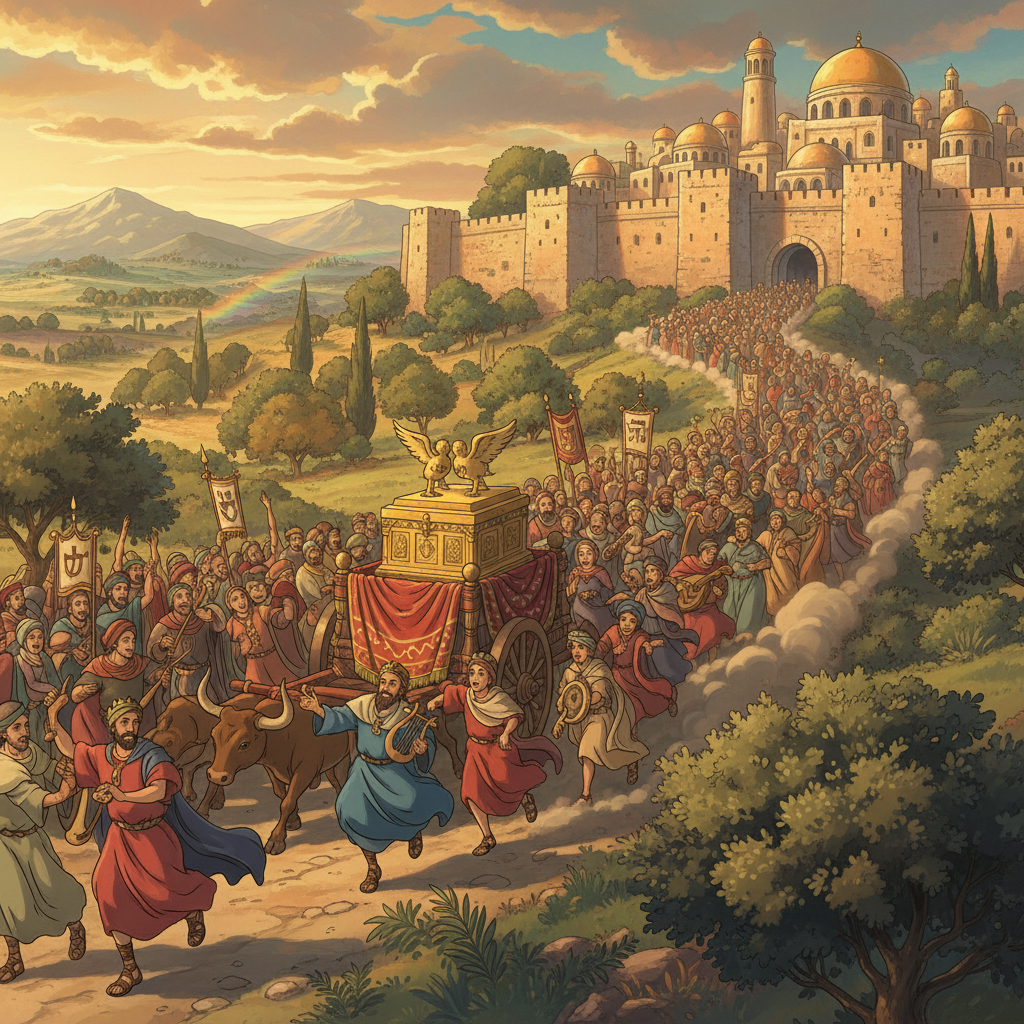
2 Samuel 6 tells us about David bringing the ark of God to Jerusalem. This chapter teaches us about respecting God, obeying His instructions, and worshipping Him with joy and a right heart. The ark of God was a special chest that showed God’s presence with the people of Israel. It had been kept in one place for a long time. David wanted to bring it to Jerusalem so that God would be at the center of the nation. Many people were happy and excited about this plan. David gathered many men and placed the ark on a new cart pulled by oxen. As they traveled, people sang, played music, and celebrated before the Lord. However, this was not the way God had instructed the ark to be carried. The ark was supposed to be carried by Levites using poles. While they were on the way, the oxen stumbled, and a man named Uzzah reached out and touched the ark to stop it from falling. God was angry because Uzzah touched the ark in a way that God had forbidden. Uzzah died, and everyone became afraid and sad. David was upset and afraid of the Lord. He decided not to take the ark to Jerusalem right away. Instead, he left it at the house of a man named Obed-Edom. God blessed Obed-Edom and his family while the ark stayed with them. After three months, David heard that God was blessing Obed-Edom. David realized that God wanted the ark to be moved in the right way. This time, the priests carried the ark properly. David celebrated with great joy, dancing before the Lord with all his strength. He wore simple clothes to show humility before God. As the ark entered Jerusalem, Michal, David’s wife, watched him from a window. She felt embarrassed and spoke badly about David’s dancing. David explained that he was dancing to honor the Lord, not to impress people. God was pleased with David’s joyful worship, but Michal’s proud attitude brought sadness into her life. 2 Samuel 6 teaches us that God is holy and must be obeyed. It also shows us that God loves joyful and sincere worship from the heart.

2 Samuel 1
January 9, 2026

2 Samuel 1: The Fallen King and a Friend's Lament

2 Samuel 1 tells us what happened after King Saul and his son Jonathan died in battle. This chapter helps us learn about truth, respect, sadness, and how to honor others even when they have wronged us. David was living in a place called Ziklag when the news arrived. Three days after David returned from fighting the Amalekites, a young man came from the battlefield of Mount Gilboa. His clothes were torn, and he had dust on his head. In Bible times, this showed that someone was very sad or mourning. The young man came to David and bowed down to show respect. David asked him where he came from, and the man said he had escaped from the Israelite army camp. David then asked what had happened in the battle. The man said that the Israelites had lost the battle, many soldiers had died, and Saul and Jonathan were dead. David was very sad to hear this news. Jonathan was David’s close friend, and even though Saul had treated David badly in the past, David still respected him because Saul was chosen by God as king. The young man then told David a story. He said that Saul was badly wounded and asked him to kill him so he would not suffer. The man claimed that he killed Saul and brought Saul’s crown and bracelet to David. The man thought David would be happy because Saul had been David’s enemy. Instead of being happy, David was upset. David believed it was very wrong to harm the Lord’s anointed king. David asked the man how he was not afraid to kill someone chosen by God. David then ordered that the man be punished for saying he killed Saul. The man was put to death because of his own words. After this, David and his men mourned deeply. They cried, fasted, and prayed for Saul and Jonathan and for the people of Israel who had died in the battle. David then sang a sad song called a lament. In this song, David praised Saul and Jonathan for their bravery and strength. He spoke especially lovingly about Jonathan, calling him a dear and close friend. David showed that it is right to honor people and remember the good they did, even when they were not perfect. This chapter teaches us to tell the truth, respect God’s authority, and show love and kindness, even to those who have hurt us.
1 Samuel 30
January 7, 2026

David's Courage: From Tears to Triumph

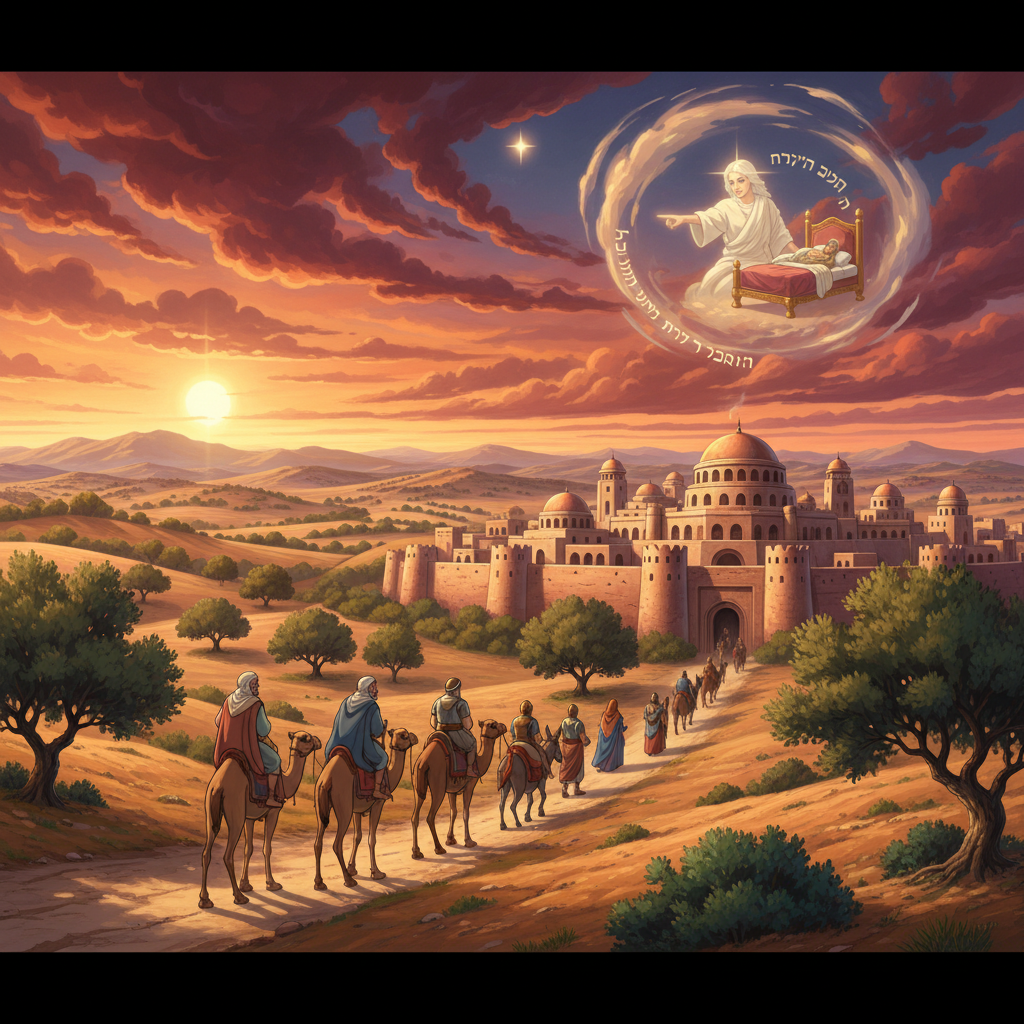
1 Samuel 30 is a powerful Bible story that teaches us about courage, prayer, leadership, and trusting God during very difficult times. David and his men had been away fighting with the Philistines. When they returned to their town called Ziklag, they were shocked and heartbroken. The Amalekites, who were enemies of Israel, had attacked the town. They burned it down and took away the women and children, including David’s two wives and the families of all his soldiers. No one was killed, but everyone was taken captive. When David and his men saw what had happened, they cried loudly until they had no strength left to cry. They were very sad and angry. Some of the men were so upset that they blamed David and even talked about killing him. This was a very dangerous moment for David. He had lost his family too, and now his own people had turned against him. Instead of giving up or fighting back in anger, David did something very important. The Bible says David encouraged himself in the Lord his God. This means he chose to trust God even when everything seemed lost. David asked the priest to bring the ephod so he could ask God for guidance. He prayed and asked, “Should I chase after the enemies? Will I catch them?” God answered David and told him to go, promising that he would surely catch them and rescue everyone. David and 600 men went after the Amalekites. Along the way, 200 men became too tired to continue and stayed behind by a stream. David did not punish them or call them lazy. He allowed them to rest while 400 men continued the journey. This shows that David was a kind and understanding leader. As they traveled, they found an Egyptian man who had been left behind by the Amalekites because he was sick. David and his men gave him food and water. When the man felt better, he told them where the Amalekites were camped. This teaches us the importance of kindness, even to strangers. David and his men attacked the Amalekites and defeated them. They rescued everyone who had been taken, including all the women and children. Nothing was missing. David also recovered everything that had been stolen. This victory showed that God keeps His promises when we trust and obey Him. After the battle, some of the soldiers wanted to keep all the rewards for themselves and give nothing to the 200 men who stayed behind. David refused. He said that everyone who helped, whether by fighting or by guarding supplies, should share equally. This teaches us about fairness and teamwork. David also sent gifts to leaders in different towns of Judah. This showed wisdom and gratitude. He understood that God had helped him, and he wanted to share the blessings with others. From 1 Samuel 30, we learn many lessons: * Pray to God when you are in trouble. * Trust God even when things look hopeless. * Be kind and fair to others. * God can turn sadness into joy. * God rewards obedience and faith.

Abraham traveled to a place called Gerar. Because Abraham was afraid that the people there might kill him to take his wife Sarah, he told them that Sarah was his sister. This was not completely true b...
Genesis 20
September 5, 2025

Genesis 20: Abraham and Sarah in Gerar: A Test of Trust

Abraham traveled to a place called Gerar. Because Abraham was afraid that the people there might kill him to take his wife Sarah, he told them that Sarah was his sister. This was not completely true because Sarah was his half-sister, but Abraham left out the fact that she was his wife. Abraham was trying to protect himself, but this was not the right choice. Abimelek, the king of Gerar, took Sarah to his palace. But God came to Abimelek in a dream and warned him that Sarah was Abraham’s wife. God told Abimelek that if he did not return Sarah, he would die because he had taken another man’s wife. Abimelek did not touch Sarah because he obeyed God’s warning. The next morning, he called Abraham and asked why he had lied. Abraham explained that he was afraid for his life. Abimelek returned Sarah to Abraham and gave him gifts, including animals and servants, to show peace and respect. God healed Abimelek and his family because he had acted honestly and obeyed God. Abraham also prayed to God, showing that God always listens to His people and protects them. Genesis 20 teaches us the importance of honesty, trusting God instead of being afraid, and showing respect and fairness to others. It also shows that God protects those who trust Him, even when they make mistakes.

Genesis 19 tells the story of the destruction of Sodom and Gomorrah. This chapter teaches us about obeying God, the danger of wickedness, and how God protects those who trust Him. Two angels visited L...
Genesis 19
September 4, 2025

Genesis 19: Sodom and Gomorrah: Lot's Escape!

Genesis 19 tells the story of the destruction of Sodom and Gomorrah. This chapter teaches us about obeying God, the danger of wickedness, and how God protects those who trust Him. Two angels visited Lot, Abraham’s nephew, in the city of Sodom. Lot welcomed them into his house and offered them food and a place to stay. That night, men from the city came to Lot’s house and wanted to harm the visitors. This shows that the people of Sodom were very wicked. The angels told Lot to gather his family and leave the city because God was going to destroy it. They warned him not to look back or stop anywhere in the plain. Lot tried to warn his sons-in-law, but they did not believe him. Lot, his wife, and his two daughters left the city as the angels instructed. God rained burning sulfur and fire on Sodom and Gomorrah, destroying the cities and all the people living there because of their sin. Lot’s wife looked back at the city even though she was told not to. Because she disobeyed God, she turned into a pillar of salt. This shows that God expects us to fully obey His instructions. Afterwards, Lot and his daughters went to live in a cave. The daughters were afraid that no men were left to marry, so they made a plan to have children by their father. This story explains how some people began to live differently after the destruction. Genesis 19 teaches us that God hates sin, warns people to turn away from evil, and protects those who trust and obey Him. It also teaches the importance of listening to God completely.

Genesis 18 tells the story of how God visited Abraham and how Abraham showed kindness, faith, and courage. This chapter teaches us about hospitality, trusting God, and praying for others. One day, Abr...
Genesis 18
September 3, 2025

Genesis 18: Abraham's Visitors: Kindness, Faith, and a Promise

Genesis 18 tells the story of how God visited Abraham and how Abraham showed kindness, faith, and courage. This chapter teaches us about hospitality, trusting God, and praying for others. One day, Abraham was sitting near the entrance of his tent when he saw three men standing nearby. Abraham ran to meet them, bowed down, and invited them to rest. He offered them water to wash, food to eat, and a place to rest. This shows how Abraham was kind and generous to strangers. While Abraham served the men, God told Abraham that Sarah, his wife, would have a son. Sarah was very old, but she laughed quietly because she thought it was impossible. God reminded her that nothing is impossible for Him, and His promise would come true. This son would be Isaac, the child through whom God’s special promises would continue. Later, Abraham spoke to God about the people living in the city of Sodom. God planned to destroy Sodom because the people were very wicked. Abraham showed courage and respect by asking God if He would save the city if there were good people living there. Abraham asked if God would spare Sodom for 50, 45, 40, 30, 20, or even 10 righteous people. God listened to Abraham and promised that He would not destroy the city if even ten righteous people were found. This chapter teaches us that God cares about people, listens to prayers, and can do anything. It also teaches us to be kind to others, trust God’s promises, and boldly pray for those in need.

When Abram was 99 years old, God appeared to him and spoke. God told Abram to live a holy life and obey Him. God made a special promise called a covenant. A covenant is like an agreement or promise be...
Genesis 17
September 2, 2025

Genesis 17: Abraham's Big Promise: A Covenant with God

When Abram was 99 years old, God appeared to him and spoke. God told Abram to live a holy life and obey Him. God made a special promise called a covenant. A covenant is like an agreement or promise between God and His people. God promised to be Abraham’s God and to give him many descendants, so many that they could not be counted. God also said that Abraham would be the father of nations and kings. Abraham would have a special son through whom God’s plan for blessing the world would continue. God changed Abram’s name to Abraham, which means “father of many nations,” to show this promise. Sarai, Abraham’s wife, also received a new name: Sarah, which means “princess.” God promised that she would have a son, even though she was very old. God also gave Abraham a special command called circumcision. Every male in Abraham’s family, including servants and descendants, was to be circumcised as a sign of the covenant. This was a way to show that Abraham and his family belonged to God and were part of His plan. Abraham obeyed God immediately, even though he was very old. He circumcised himself, his son Ishmael, and all the men in his household. This shows that Abraham trusted God and was willing to follow His instructions. Genesis 17 teaches us to obey God, trust His promises, and remember that God has a special plan for those who belong to Him. God always keeps His word.

Genesis 16 tells the story of Hagar and Ishmael. This chapter teaches us about patience, trusting God’s timing, and how God cares for everyone, even when people make mistakes. Sarai, Abram’s wife, had...
Genesis 16
September 1, 2025

Genesis 16: Hagar and Ishmael: God Hears

Genesis 16 tells the story of Hagar and Ishmael. This chapter teaches us about patience, trusting God’s timing, and how God cares for everyone, even when people make mistakes. Sarai, Abram’s wife, had not been able to have children, and she wanted God’s promise of a son to come true. She gave her servant Hagar to Abram so that she could have a child through her. This was a common custom at the time, but it was not God’s plan. Hagar became pregnant, and this caused trouble in the household. Hagar began to look down on Sarai, and Sarai treated Hagar harshly. Hagar ran away into the wilderness because she felt unhappy and mistreated. While Hagar was in the desert, an angel of the Lord appeared to her. The angel told Hagar to return and submit to Sarai. The angel also gave Hagar a special promise: her son would have many descendants and become a great nation. The angel told Hagar to name her son Ishmael, which means "God hears," because God had heard her troubles. Hagar went back to Abram, and she had a son named Ishmael. Even though Sarai and Abram had not done everything the right way, God still kept His promise to care for Hagar and her son. Genesis 16 teaches us that we should trust God’s timing and ways, not try to make things happen in our own way. It also teaches that God notices when we are hurting and provides care and hope.

One night, God spoke to Abram in a vision. God told Abram not to be afraid and reminded him that He would protect him. God also promised Abram that he would have many descendants, even though Abram an...
Genesis 15
August 31, 2025

Genesis 15: Abram's Big Promise: A Night Under the Stars

One night, God spoke to Abram in a vision. God told Abram not to be afraid and reminded him that He would protect him. God also promised Abram that he would have many descendants, even though Abram and his wife Sarai did not have any children yet. Abram believed God, and God counted his faith as righteousness. This means that Abram trusted God completely, and God was pleased with him. This shows us how important it is to have faith in God, even when we cannot see what will happen. God then made a promise about the land that Abram’s descendants would one day inherit. Abram asked God how he would know that he would have this land. God gave Abram a special instruction. Abram prepared animals, cut them in half, and laid them on the ground. At night, God sent a deep sleep over Abram. While Abram slept, God spoke about the future. He told Abram that his descendants would live in a foreign land and be treated badly for 400 years, but God would punish the people who oppressed them and bring them out with many possessions. God also promised the exact land that Abram’s descendants would inherit. Genesis 15 teaches us that God keeps His promises, that trusting Him is very important, and that He has plans for our future, even if we cannot see them right away. Abram’s faith shows us the example of believing God completely.

Genesis 14 tells the story of a battle between kings and how Abram (later called Abraham) showed bravery, faith, and trust in God. This chapter teaches us about courage, helping others, and giving tha...
Genesis 14
August 30, 2025

Genesis 14: Abram's Brave Rescue: Trusting God in Battle!

Genesis 14 tells the story of a battle between kings and how Abram (later called Abraham) showed bravery, faith, and trust in God. This chapter teaches us about courage, helping others, and giving thanks to God. At that time, some kings from the east attacked the cities of the plain, including Sodom and Gomorrah, where Lot was living. Lot and his possessions were captured during the attack. When Abram heard that his nephew was taken, he acted quickly. Abram gathered 318 trained men from his own household and chased the attackers. Even though Abram had a small number of men, God gave him victory. Abram and his men defeated the kings and rescued Lot, along with the people and possessions that had been taken. This shows that God helps those who trust Him, even in difficult situations. After the battle, Abram met a man named Melchizedek. Melchizedek was a priest of God Most High and also a king. He blessed Abram and praised God for giving Abram victory. Abram gave Melchizedek a tenth of everything he had captured. This teaches us about honoring God and giving thanks for His help. The king of Sodom also came to Abram and offered him the possessions that had been recovered. Abram refused to take them, saying he would not let anyone say that he had become rich from the king. Abram wanted to honor God for the victory. Genesis 14 teaches us to be brave, to trust God in tough situations, to help others, and to give thanks to God for His protection and blessings.

Genesis 13 tells the story of Abram and his nephew Lot and how they learned to make wise choices. This chapter teaches us about faith, peace, and trusting God to provide for us. After Abram returned f...
Genesis 13
August 29, 2025

Genesis 13: Abram and Lot: Choosing Peace

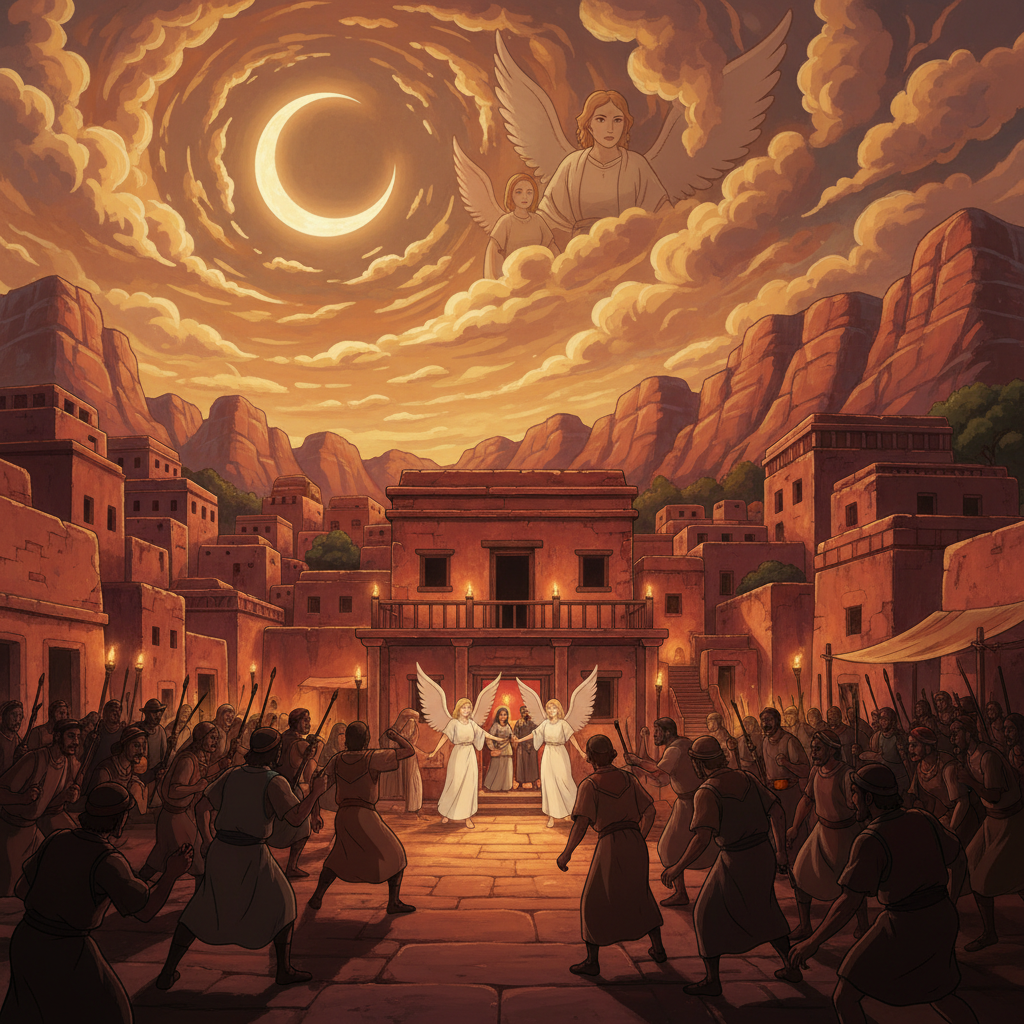
Genesis 13 tells the story of Abram and his nephew Lot and how they learned to make wise choices. This chapter teaches us about faith, peace, and trusting God to provide for us. After Abram returned from Egypt, he was very rich. He had many animals, silver, gold, and servants. Lot also had many animals and servants. Because both Abram and Lot had so many possessions, the land could not support all of them living together. There were not enough resources for both their families and animals, and arguments started between their servants. Abram wanted peace, so he gave Lot the choice of which land he wanted to live in. Abram trusted God to take care of him, so he did not need to argue or fight. Lot chose to live in the fertile plain of Jordan near the city of Sodom. Abram stayed in Canaan, trusting God’s promises. After Lot left, God spoke to Abram and promised that all the land he could see would belong to him and his descendants forever. God reminded Abram that his descendants would be as many as the dust of the earth. Abram built an altar there to worship God and thank Him. This chapter teaches us the importance of making peaceful choices, trusting God instead of competing, and relying on God to provide for us. Abram showed faith and humility, and God rewarded him.
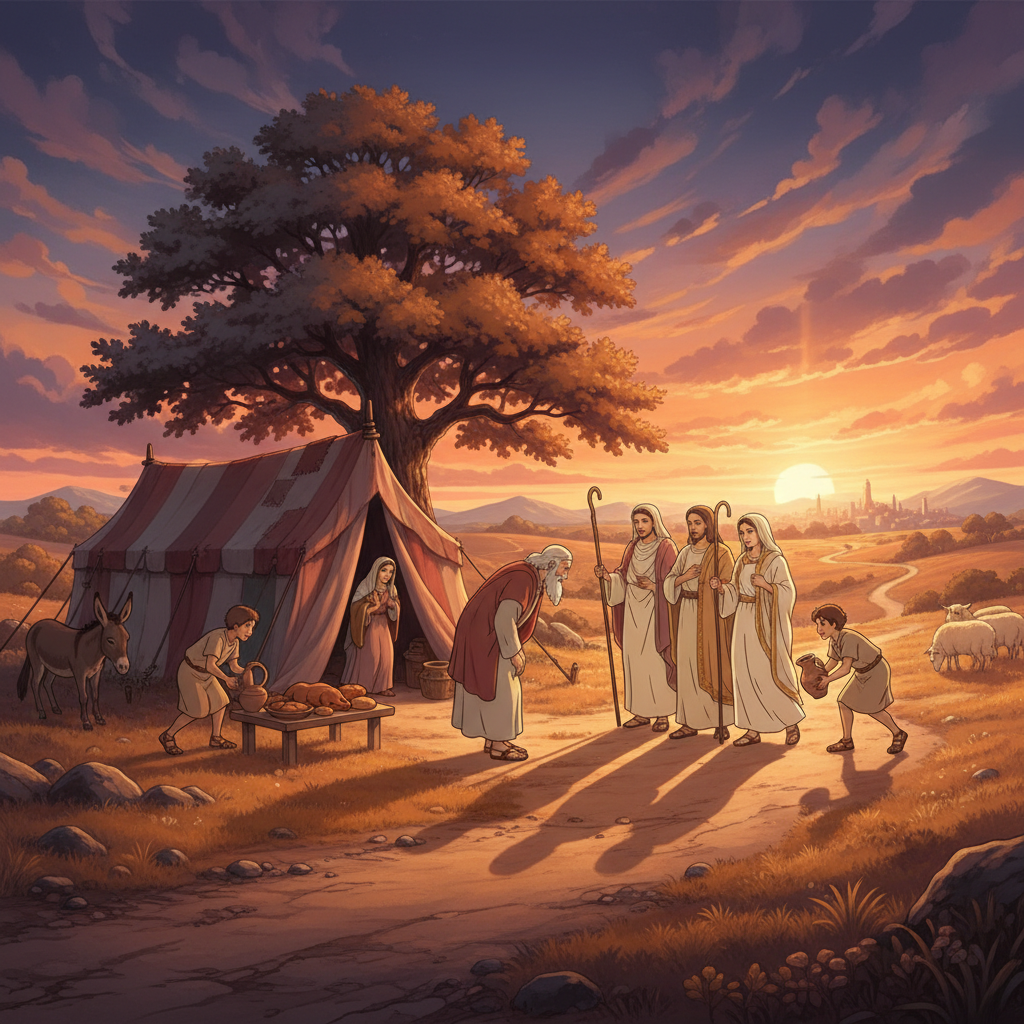


Genesis 12 tells the story of Abram, who later became Abraham, and how God called him to leave his home and trust Him. This chapter teaches us about faith, obedience, and God’s promises. At this time,...
Genesis 12
August 28, 2025

Genesis 12: Abram's Big Adventure: Trusting God's Call

Genesis 12 tells the story of Abram, who later became Abraham, and how God called him to leave his home and trust Him. This chapter teaches us about faith, obedience, and God’s promises. At this time, Abram was living in a place called Ur with his family. God spoke to Abram and told him to leave his country, his people, and his father’s house. God promised to take him to a new land that He would show him. This was a big step because Abram did not know where he was going. God also made Abram some amazing promises. God promised to make Abram into a great nation, to bless him, and to make his name famous. God said that through Abram, all the families of the earth would be blessed. This means that God had a plan to bring His blessings to everyone through Abram and his descendants. Abram obeyed God right away. He took his wife Sarai, his nephew Lot, and all their possessions and servants, and they traveled to Canaan, the land God had promised them. This shows that Abram trusted God even when he could not see the full plan. When Abram arrived in Canaan, God appeared to him and promised again that He would give this land to Abram’s descendants. Abram built an altar to worship God. This shows that he thanked God and honored Him. Later, there was a famine in the land, and Abram went to Egypt to live for a while. Abram made some mistakes during this time because he was afraid, but God protected him. Even when we make mistakes, God still keeps His promises and cares for us. Genesis 12 teaches us to trust God, obey Him, and have faith that His promises are true. It also shows that God blesses those who follow Him.

Genesis 11 tells the story of the Tower of Babel. This chapter teaches us about pride, disobedience, and how God can guide people when they choose wrong. It also explains why people began to speak dif...
Genesis 11
August 27, 2025

Genesis 11: The Tower of Babel: When Words Got Mixed Up!

Genesis 11 tells the story of the Tower of Babel. This chapter teaches us about pride, disobedience, and how God can guide people when they choose wrong. It also explains why people began to speak different languages and spread across the earth. After the flood, people began to live together in one place. They all spoke the same language and worked together. They decided to build a great city with a very tall tower. They wanted the tower to reach the sky so that everyone would be famous and so they would not have to spread out and fill the earth, as God had commanded Noah. The people were proud and thought they could make a name for themselves without obeying God. They were not listening to God’s command to spread across the earth. God saw what they were doing and was concerned because their pride could lead to more sin. God decided to confuse their language so that they could not understand each other. Suddenly, people could not communicate, and the work on the tower stopped. Because they could not understand each other, they scattered across the earth and settled in different lands. The city that was being built was called Babel, which means confusion. This event explains why there are many languages in the world today. Even though people disobeyed, God had a plan for the earth and ensured that His plan continued through different nations and families. Genesis 11 teaches us that pride and disobedience are serious. It also shows that God is in control, that He guides people, and that His plans cannot be stopped by human arrogance.

Genesis 10
August 27, 2025

Genesis 10: The Table of Nations

Genesis 10 Genesis 10 is called the Table of Nations. It tells us about the descendants of Noah’s three sons: Shem, Ham, and Japheth, and how the nations and people spread across the earth after the flood. This chapter helps us understand that all people come from Noah’s family and that God is in control of how the world is filled. After the flood, Noah’s sons had children, and their families grew. Japheth’s descendants lived mostly in the lands around Europe and the coastlands. Ham’s descendants settled in Africa and some parts of the Middle East. Shem’s descendants lived in the area called the Middle East, including the ancestors of the Israelites. The chapter lists many names of sons and grandsons and tells which lands they settled. This shows that different families became nations. God allowed people to spread across the earth, fill it, and take care of it, as He had commanded Noah. Genesis 10 teaches us that all people are connected through Noah’s family. It also shows God’s plan for people to live in different places and that every nation has a beginning. Even though people are different, God loves all of them. This chapter also reminds us that God is in control of history. He oversees the growth of nations and the movement of people across the earth. Even in diversity, God’s plan continues.

Genesis 9
August 26, 2025

Genesis 9: God's Promise and Noah's Vineyard

Genesis 9 After Noah, his family, and the animals came out of the ark, God blessed them. He told Noah and his sons to be fruitful and multiply. This means they were to have children and fill the earth with people. God gave them the earth to live on and take care of, just as He had given it to Adam before the flood. God also told them that they could eat animals for food. But He made one rule: they were not to eat meat that still had blood in it. The blood represents life, and God wanted people to respect life. God warned that anyone who shed the blood of another person would have to face justice. God said that humans are made in His image, which makes every life very important. Then God made a very special promise. He promised that He would never again destroy the whole earth with a flood. God gave a sign of His promise: the rainbow. When we see a rainbow in the sky, it reminds us that God keeps His promises and cares for the world. The chapter also tells the story of Noah and his sons after the flood. Noah became a farmer and planted a vineyard. One day, he drank wine from his vineyard and became drunk. He lay uncovered in his tent. Ham, one of Noah’s sons, saw him and told his brothers. Shem and Japheth covered their father respectfully without looking at him. When Noah woke up, he blessed Shem and Japheth but punished Ham’s son, Canaan. This story teaches respect and honor in families. Genesis 9 teaches us about God’s blessings, His care for life, His promises, and the importance of respect and obedience.

Genesis 8
August 25, 2025

Genesis 8: Noah's Ark: The Waters Recede

Genesis 8 After many days of flood, God remembered Noah and all the animals in the ark. This does not mean God had forgotten them before. It means God was ready to act and help them. God caused a wind to blow over the earth, and the waters began to go down. The rain stopped, and the waters slowly went down over many months. The ark came to rest on the mountains of Ararat. Even though the ark stopped moving, the earth was still covered with water. After some time, the tops of the mountains could be seen. Noah waited patiently. He opened a window of the ark and sent out a raven, but it kept flying back and forth. Then Noah sent out a dove to see if the land was dry, but the dove found no place to rest and returned to the ark. Noah waited seven more days and sent the dove out again. This time, the dove came back with a fresh olive leaf in its beak. This showed that plants were growing again and the land was becoming dry. Noah waited another seven days and sent the dove out once more. This time, the dove did not return, showing that the earth was ready. God then told Noah to come out of the ark with his family and all the animals. They were to spread out and fill the earth again. After leaving the ark, Noah built an altar and offered a sacrifice to God to say thank You. God was pleased with Noah’s worship. God promised that He would never again destroy the whole earth with a flood. God also promised that the seasons would continue as long as the earth remained. Genesis 8 teaches us that God remembers His people, answers at the right time, and keeps His promises.

Genesis 7
August 24, 2025

Genesis 7: Noah's Ark - The Great Flood!

Genesis 7 God told Noah that the time had come for the flood to begin. God said that Noah was the only person living righteously among the people of his time. God instructed Noah to enter the ark with his wife, his sons, and their wives. God also told Noah to bring animals into the ark. From animals that were considered clean, Noah was to take seven pairs. From animals that were not clean, he was to take one pair. He was also to bring birds so they could live after the flood. This showed that God cared about every living thing. God told Noah that rain would fall for forty days and forty nights. After seven days, everything happened just as God said. Rain poured down from the sky, and water burst up from the ground. Soon, water covered the whole earth. The floodwaters became deeper and deeper. Even the highest mountains were covered. Every living thing outside the ark died. Only Noah, his family, and the animals inside the ark remained alive. God Himself shut the door of the ark. This showed that God was in control and that those inside the ark were safe. The ark floated on the water for many days while the rain continued. The floodwaters covered the earth for one hundred and fifty days. During all that time, Noah and his family stayed safe inside the ark because they trusted and obeyed God. Genesis 7 teaches us that God keeps His promises. It also teaches us that obedience brings protection and that God cares for those who follow Him.

Genesis 6
August 23, 2025

Genesis 6: Noah's Ark - A Flood of Faith

Genesis 6 As time passed, more people filled the earth. Sadly, people began to do many bad things. Their thoughts and actions were full of evil all the time. This made God very sad because He had created people to live in love and goodness. God saw that the world had become corrupt and violent. People were hurting one another and refusing to obey God. God decided that He would cleanse the earth with a flood. This showed that God is holy and does not enjoy evil. However, God did not forget mercy. One man stood out among the people. His name was Noah. The Bible says that Noah was a righteous man and walked with God. This means Noah loved God and tried to obey Him even when others did not. God spoke to Noah and told him about His plan to send a flood. God gave Noah very clear instructions to build a large boat called an ark. The ark was to be made of wood and built in a special way so it would float safely on the water. God told Noah to bring his family into the ark. Noah had three sons named Shem, Ham, and Japheth. God also told Noah to bring animals into the ark, two of every kind, male and female, so they would survive the flood. Noah was also told to store food for his family and the animals. Noah obeyed God completely. Even though it had never rained like that before, Noah trusted God’s word. The chapter ends by telling us that Noah did everything just as God commanded him. Genesis 6 teaches us that God notices how people live, that sin brings serious results, and that God always provides a way of rescue for those who obey Him.

Genesis 5
August 22, 2025

Genesis 5: The Long Line of Faith

Genesis 5 Genesis 5 is a chapter that tells us about the family line from Adam to Noah. This list of families is called a genealogy. It helps us see how people lived, how long they lived, and how God kept His plan going from one generation to another. The chapter begins by reminding us that God created people in His own image. Even after sin entered the world, God still cared for people and continued to bless families. Adam had many sons and daughters, and people began to fill the earth. Genesis 5 lists the names of fathers and their sons, such as Adam, Seth, Enosh, Kenan, Mahalalel, Jared, Enoch, Methuselah, Lamech, and Noah. For each person, the Bible tells how old they were when they had a son, how long they lived afterward, and then says that they died. This reminds us that sin brought death into the world, just as God had warned. One person in this chapter is very special. His name is Enoch. The Bible says that Enoch walked with God. This means he lived a life that pleased God and stayed close to Him. Instead of dying like the others, Enoch was taken by God. This shows that God rewards those who faithfully follow Him. Another important person is Methuselah. He lived longer than anyone else mentioned in the Bible, reaching 969 years. His long life reminds us of God’s patience and mercy toward people. The chapter ends with the birth of Noah. Noah’s father, Lamech, said that Noah would bring comfort because life had become very hard due to sin. Noah would later play an important role in God’s plan to save life on earth. Genesis 5 teaches us that God is faithful through every generation. It also reminds us that life is a gift from God and that walking with God is more important than how long we live.

Genesis 4
August 21, 2025

Genesis 4: Cain and Abel: The Seed of Sin

Genesis 4: The First Murder Adam and Eve had two sons. The first son was named Cain, and the second son was named Abel. Cain became a farmer who worked the land. Abel became a shepherd who took care of sheep. Both brothers brought offerings to God. Cain brought some of the fruits from his farm. Abel brought the best parts of his sheep. God accepted Abel’s offering, but He did not accept Cain’s offering. God was pleased with Abel because Abel gave his best and obeyed God with a sincere heart. Cain became very angry and jealous. His face showed how upset he was. God spoke to Cain and warned him. God told Cain that if he did what was right, he would be accepted. God also warned Cain that sin was like something waiting to take control of him, and he needed to choose to do what was right. Instead of listening to God, Cain became more angry. One day, Cain asked Abel to go into the field with him. While they were there, Cain attacked Abel and killed him. This was the first time one person killed another person in the Bible. God asked Cain where his brother Abel was. Cain answered with a rude question and said he did not know. God already knew what Cain had done. God told Cain that Abel’s blood cried out from the ground, showing that God sees every wrong action. God punished Cain by making him a restless wanderer. The ground would no longer produce crops for him. Cain was afraid that others would kill him, but God showed mercy. God put a mark on Cain to protect him so no one would harm him. Cain then left and lived in another land. The chapter later tells us that Adam and Eve had another son named Seth. God gave Seth to replace Abel. From Seth’s family came people who began to call on the name of the Lord. Genesis 4 teaches us that jealousy and anger can lead to terrible choices. It also teaches us that God warns us before we sin and still shows mercy even when we do wrong.

Genesis 3
August 21, 2025

Genesis 3: The Forbidden Fruit: Adam & Eve's Big Mistake

Genesis 3 In the Garden of Eden, God had given Adam and Eve everything they needed. He had given them only one rule. They were not to eat from the tree of the knowledge of good and evil. God gave this rule to help them learn to trust and obey Him. One day, a serpent came to Eve. The serpent was very crafty and tried to trick her. The serpent asked Eve if God really said they must not eat from the tree. Eve explained God’s command, but the serpent lied. He told her that she would not die and that she would become like God if she ate the fruit. Eve looked at the fruit and saw that it looked good and pleasing. She chose to believe the serpent instead of God. She ate the fruit and then gave some to Adam, and he ate it too. At that moment, they disobeyed God. After eating the fruit, Adam and Eve noticed that they were naked, and they felt ashamed. They sewed fig leaves together to cover themselves. When they heard God walking in the garden, they hid because they were afraid. God called out to Adam and asked where he was. Adam said he was afraid because he was naked. God asked who told him that and if he had eaten from the forbidden tree. Adam blamed Eve, and Eve blamed the serpent. No one wanted to take responsibility for their wrong choice. God then explained the results of their sin. The serpent was cursed. The woman would now experience pain in childbirth. The man would have to work hard to grow food from the ground. Life would no longer be easy. Because of their sin, Adam and Eve could no longer stay in the Garden of Eden. God sent them out so they would not eat from the tree of life and live forever in sin. God placed angels to guard the garden. Even though Adam and Eve disobeyed God, God still showed love and care. He made clothes for them and promised that one day a Savior would come to defeat evil. This shows that God does not stop loving us when we make mistakes. Genesis 3 teaches us that disobeying God brings trouble, but God is loving and ready to forgive when we turn back to Him.

Genesis 2
August 20, 2025

Genesis 2: The First Garden

Genesis 2 After God finished creating the world in six days, He rested on the seventh day. God was not tired, but He rested to show that rest is important. He blessed the seventh day and made it holy. This teaches us that God wants people to take time to rest and spend time with Him. Genesis 2 then explains how God created the first man. God formed the man from the dust of the ground and breathed life into him. The man became a living person. This shows that life comes from God. God planted a beautiful garden called the Garden of Eden. In the garden, God placed the man and gave him everything he needed. There were many trees with good food. Two special trees were in the middle of the garden. One was the tree of life, and the other was the tree of the knowledge of good and evil. God gave the man a job to do. He was to work in the garden and take care of it. God told the man that he could eat from any tree except the tree of the knowledge of good and evil. God warned him that eating from that tree would bring death. This rule was given to help the man learn obedience and trust. God saw that it was not good for the man to be alone. So God decided to make a helper who was just right for him. God brought the animals to the man so he could name them, but none of them were a perfect helper for him. Then God caused the man to fall into a deep sleep. God took one of the man’s ribs and made a woman. When the man saw her, he was very happy. The man and woman were made to be companions, to love and help each other. The chapter ends by telling us that the man and woman were both naked and felt no shame. This means they were innocent and lived peacefully with no fear or wrongdoing. Genesis 2 teaches us that God created people with love, gave them responsibility, values rest, and designed families and friendships for our good.

Genesis 1
August 19, 2025

Genesis 1: God Creates the World!

Genesis 1 In the beginning, there was nothing except darkness and emptiness. God’s Spirit was moving over the waters. Then God began to create the world by speaking. When God spoke, things happened. This shows us that God’s word is powerful. On the first day, God created light. He separated the light from the darkness. He called the light day and the darkness night. This gave the world time and order. On the second day, God made the sky. He separated the waters below from the waters above. The sky became the space above the earth. On the third day, God gathered the waters together so dry land could appear. He called the dry land earth and the gathered waters seas. Then God made plants, grass, flowers, and trees. These plants could make seeds so they could grow again and again. On the fourth day, God made the sun, moon, and stars. The sun was made to rule the day, and the moon was made to rule the night. The stars filled the sky. These lights helped people know days, seasons, and years. On the fifth day, God created animals that live in the water, like fish, and animals that fly in the sky, like birds. God blessed them and told them to grow and fill the seas and the sky. On the sixth day, God created animals that live on land, such as cattle, wild animals, and small creatures. Then God created people. God made humans in His own image, meaning people can think, love, choose, and care for others. God made both male and female. He told them to care for the earth and everything in it. When God finished creating everything, He saw that it was very good. This means God was pleased with His creation. Genesis 1 teaches us that God is the Creator of all things, that everything God made has a purpose, and that people are special because they are made in God’s image.

Numbers 7
August 18, 2025

Numbers 7: Gifts for God's House

CHAPTER : Numbers 7 In Numbers chapter 7, the leaders of the Israelites bring gifts to the tabernacle to dedicate it to God. The tabernacle is like a special house for God, and the leaders want to make it beautiful and ready for God to live among them. The leaders bring different gifts, like: - Wagons and oxen to help carry the tabernacle's parts - Plates, bowls, and spoons for serving food and offerings - Gold and silver decorations to make the tabernacle look beautiful Just like scientists use different tools and equipment to conduct experiments, the Israelites used different gifts to help with the tabernacle's dedication. Each gift was special and important in its own way, just like each tool has its own special job. Each leader took turns bringing their gifts to the tabernacle. It's like taking turns in a game or sharing toys with friends.

Numbers 6
August 17, 2025

Numbers 6: The Nazirite Promise

CHAPTER : Numbers 6 In Numbers chapter 6, God gives special rules for people called Nazirites. A Nazirite is someone who makes a promise to God to be extra special and dedicated to Him for a while. The Nazirites had to follow three main rules: 1. They didn't drink wine or eat grapes. It's like avoiding certain foods that might not be good for you. 2. They didn't cut their hair. It's like growing your hair long as a symbol of your promise to God. 3. They stayed away from dead bodies to stay pure and clean. It's like washing your hands to avoid germs. Just like a scientist follows specific rules in an experiment to get the right results, Nazirites followed these rules to show their love and dedication to God. By keeping these rules, they showed God they were serious about their promise. The chapter also talks about a special blessing that the priests would say over the people. It's like a prayer that asks God to bless and protect His people.

Numbers 5
August 16, 2025

Numbers 5: Cleanliness, Fairness, and Truth

CHAPTER : Numbers 5 In Numbers chapter 5, God gives instructions about cleanliness and fairness in the Israelites' community. God tells the Israelites to remove people with skin diseases from the camp to keep everyone healthy. It's like when we wash our hands to prevent the spread of germs. If someone does something wrong to another person, they need to make it right by paying back what they owe. It's like returning a borrowed toy or apologizing for hurting someone's feelings. The chapter also talks about a wife who might be unfaithful to her husband. A special test is described to determine if she's been faithful. It's like a detective investigation to figure out the truth. Just like a scientist uses tests and experiments to figure out the truth, the Israelites used a special ritual to determine if someone was guilty or innocent. The idea is to find out the truth and make things right.

Numbers 4
August 15, 2025

Numbers 4: The Tabernacle Team!

CHAPTER : Numbers 4 In Numbers chapter 4, God gave instructions to the Levites about taking care of the tabernacle. The tabernacle was like a big, special tent where God lived among the Israelites. Imagine the tabernacle is like a space station, and the Levites are the astronauts who take care of it. Just like astronauts have specific jobs to keep the space station running smoothly, the Levites had specific jobs to keep the tabernacle in order. The Kohathites were in charge of carrying the sacred objects, like the Ark of the Covenant. It's like they're handling precious cargo that needs to be transported safely. The Gershonites took care of the tabernacle's framework, like the walls and curtains. They're like the engineers who make sure the space station's structure is strong and secure. The Merarites were responsible for the tabernacle's boards, bars, and pillars. They're like the construction team that keeps the space station's foundation solid. Just like a team of scientists and engineers work together to launch a rocket into space, the Levites worked together to take care of the tabernacle. Each group had a specific role, and they all worked together to make sure everything ran smoothly.

The Levites
August 14, 2025

The Levites: Guardians of the Tabernacle

CHAPTER : Numbers 3 In Numbers chapter 3, God talks about the Levites, a special group of people who helped the priests with the tabernacle. The tabernacle was like a big tent where God lived among the Israelites. The Levites were in charge of taking care of the tabernacle and its furniture. They had to make sure everything was clean and in its right place. God chose the Levites to do this important work because they were faithful and willing to serve. The chapter also talks about the different families of Levites and their responsibilities. Some Levites were in charge of the tabernacle's framework, while others took care of the sacred objects.

Numbers 2
August 13, 2025

Numbers 2: Camping with God!

CHAPTER : Numbers 2 A long time ago, the Israelites were in the wilderness. God told them how to set up their camp. They had to arrange their tents in a special order around the tabernacle, which was like a big tent where God lived. The Israelites were divided into 12 tribes, and each tribe had its own flag. They camped in groups of three tribes on each side of the tabernacle. The Levites, who were special helpers, camped closest to the tabernacle. The order of the tribes was important because it showed how God wanted them to be organized and work together. It also helped them remember their importance in God's plan.

Numbers 1
August 12, 2025

Numbers 1: Counting God's People

CHAPTER : Numbers 1 A long time ago, the Israelites were in the wilderness. God told Moses to count all the people who were at least one month old. This was important so God could know how many people there were. The Israelites were divided into 12 tribes, each named after one of Jacob's sons. Each tribe had a leader who helped count the people. The leaders counted the people in their tribes and reported the numbers to Moses and Aaron. The total number of men who were at least 20 years old and able to fight in the army was 603,550. The Levites were not counted with the other tribes because they were special helpers in the tabernacle.

Leviticus 27
August 11, 2025

Leviticus 27: Keeping Promises to God

CHAPTER : Leviticus Chapter 27 In Leviticus 27, God gave Moses rules about making promises, called vows, to Him. Sometimes people promised to give something special to God, like themselves to serve, an animal, land, or money. God told the people that if they made a promise, they had to keep it. If they wanted to give something else instead of what they promised, they could, but they had to add a little extra to show they were serious. If someone promised an animal to God, it became holy and could not be used for other work. If they promised a house or a piece of land, the priests would decide how much it was worth, and that value would be given to God. God also reminded them about the special tenth part of everything they had, called the tithe. This tithe belonged to God and was holy. It was a way of thanking Him for all He had given. This chapter taught the people that God took promises seriously and wanted them to give to Him with respect and joy. Today, we learn that when we promise something to God, we must keep our word and give cheerfully.

Leviticus 26
August 10, 2025

Leviticus 26: God's Promises and Rules

CHAPTER : Leviticus Chapter 26 In Leviticus 26, God is talking to the Israelites about being good and following His rules. God says that if they are good and follow His rules, He will give them lots of blessings, like good food, happy times, and safety. But if they don't listen and don't follow His rules, things might not go so well. They might get sick, or have problems with food, or feel scared. God wants the Israelites to remember that He loves them and wants the best for them. He wants them to be happy and live good lives.

Leviticus 25
August 9, 2025

Leviticus 25: The Year of Rest and Freedom!

CHAPTER : Leviticus Chapter 25 In Leviticus 25, God is teaching the Israelites about being kind to others and taking care of the land. God says that every 7 years, the land should rest, and they shouldn't plant or harvest anything. This is called the Sabbath year. Also, every 50 years, there's a special year called the Year of Jubilee. During this year, everyone gets their land back, and people who were sold as servants get to go free. God wants the Israelites to be fair and kind to each other. He wants them to remember that the land belongs to Him, and they're just taking care of it.

Leviticus 24
August 8, 2025

Leviticus 24: Lamps, Bread, and Respect!

CHAPTER : Leviticus Chapter 24 In Leviticus 24, God is talking to the Israelites about keeping the special lamp in the Temple lit. This lamp is like a big candle that burns oil, and it needs to be taken care of. God also tells them about the special bread they need to put on the table in the Temple. This bread is like a gift to God, and it needs to be fresh and nice. Then, there's a story about a man who says bad words to God and gets punished. God wants people to be kind and respectful when talking about Him. The main idea is that God wants the Israelites to take care of the special things in the Temple and be respectful to Him.

Leviticus 23
August 7, 2025

Leviticus 23: God's Special Celebration Days!

CHAPTER : Leviticus Chapter 23 In Leviticus 23, God is telling the Israelites about special days to celebrate. These days are like holidays, and they're a big deal! God wants the Israelites to remember important things He did for them, like helping them escape from slavery. They have to do special things on these days, like rest, gather together, and be happy. Some of these special days are: - The Sabbath (a day of rest) - Passover (remembering when God helped them escape slavery) - Feast of Unleavened Bread (eating special bread) - Feast of Weeks (giving thanks for harvest) - Feast of Trumpets (blowing trumpets) - Day of Atonement (asking for forgiveness) - Feast of Tabernacles (living in special booths) God wants the Israelites to have fun and be thankful on these special days.